- 6 min read
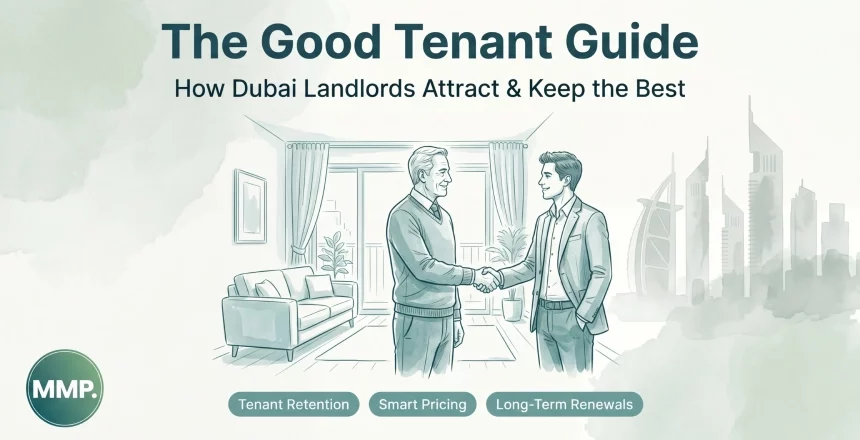
Here is something most landlords learn the hard way: great tenants do not materialise by luck. They are attracted — and, more importantly, they are kept — by deliberate decisions that most landlords either do not know about or simply do not get around to making.
In a Dubai rental market that is maturing and offering tenants more choice than they have had in years, this matters more than ever. The era of ‘list it and they will come’ is not over — demand is still strong — but the era of ‘they will stay no matter what’ definitely is.
This is a practical guide for Dubai property owners who want to think about their tenancy relationships as an asset, not an afterthought. Because the landlords consistently generating the best returns from their Dubai real estate investment management are not necessarily the ones with the best-located properties. They are the ones whose tenants keep renewing.
Understand What a Good Tenant Leaving Actually Costs You
Before anything else, let’s be honest about the numbers — because most landlords dramatically underestimate the financial impact of losing a tenant they liked.
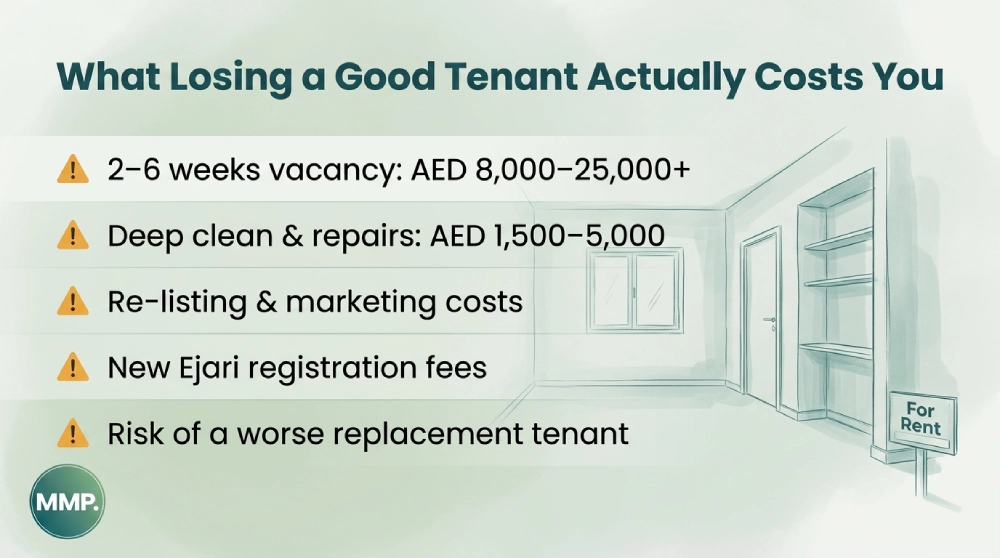
It is tempting to think of vacancy as ‘a few weeks without rent.’ In reality, tenant turnover is one of the most expensive events in a rental property’s lifecycle. According to data from the Dubai rental market, the average vacancy period between tenancies runs between two and six weeks. In a mid-market Dubai apartment generating AED 80,000 per year, that is AED 3,000–9,000 in lost income before you’ve spent a single dirham on anything else.
When a good tenant leaves, you face: | Realistic cost range (AED) |
Vacancy period (2–6 weeks average) | Lost rent: AED 8,000–25,000+ |
Re-listing & marketing | AED 500–1,500 |
Deep clean & touch-up repairs | AED 1,500–5,000 |
New Ejari registration | AED 220 |
Tenant screening & viewings (time) | Unquantifiable, but real |
Risk of the next tenant being worse | Unquantifiable, but real |
Add it up and a single avoidable tenant departure can cost a landlord anywhere from one to three months’ equivalent rent — before accounting for the risk that the next tenant is less reliable than the one who just left.
The real maths of tenant retention: Spending AED 2,000 on a fresh coat of paint and prompt maintenance to keep a great tenant for another year is not a cost. It is an investment that pays back several times over when you factor in what turnover actually costs. |
Price for Retention, Not for the Record Books
Overpricing is, without question, the most expensive mistake a Dubai landlord can make. A property listed 10% above market does not attract 10% fewer enquiries — it often attracts almost none. Tenants in 2026 are savvy, well-informed, and comparing your listing against everything else available in real time.
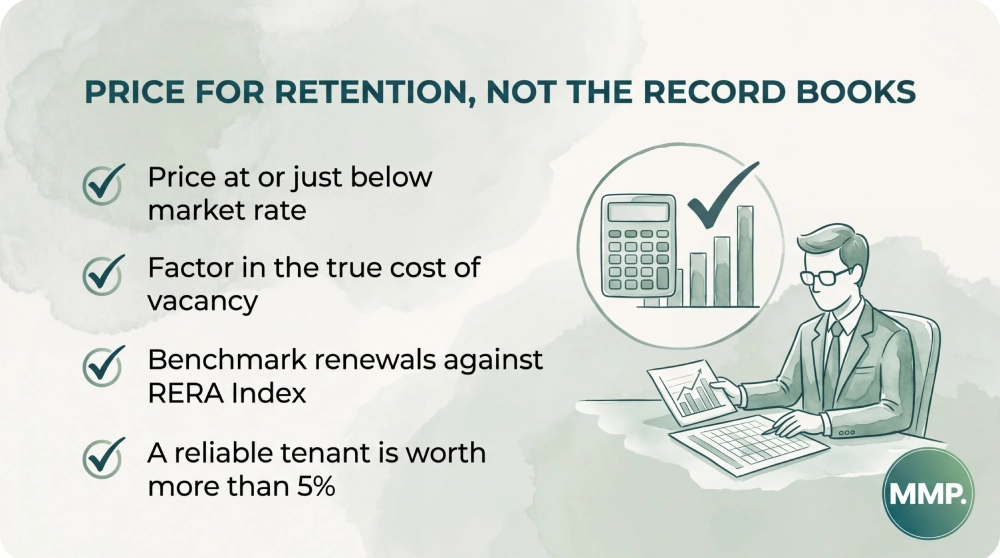
But the pricing mistake that costs landlords even more than overpricing on a new listing is overpricing at renewal. Pushing an existing great tenant to the very ceiling of what the RERA Rental Index permits — especially when that tenant has been reliable, paid on time, and caused no problems — is a calculation that rarely makes financial sense when you run the full numbers.
Consider this: a 5% rent increase on a well-run AED 90,000 tenancy generates AED 4,500 in additional income. If that increase pushes a reliable tenant to look elsewhere and they leave, you could easily lose AED 15,000–25,000 to vacancy, re-listing, and the costs of resetting the property. The 5% gain evaporates — and then some.
The 2026 market context: According to Arabian Business reporting on Dubai’s rental outlook, landlords are increasingly prioritising retention over short-term rent maximisation as more supply enters the market. Tenants who show reliability and commit to longer leases now have genuine leverage to negotiate — and the smartest landlords are working with that rather than against it. |
Price at market or just below it for quality tenants. The small reduction in annual yield is almost always more than offset by the compound value of continuity — no vacancy, no re-listing, no risk of a worse replacement.
Maintenance Is Not Optional — It’s Your Strongest Retention Tool
Ask any property manager in Dubai what the single most common reason for a good tenant choosing not to renew is, and the answer is almost always the same: maintenance. Not the rent level. Not the building. Maintenance.
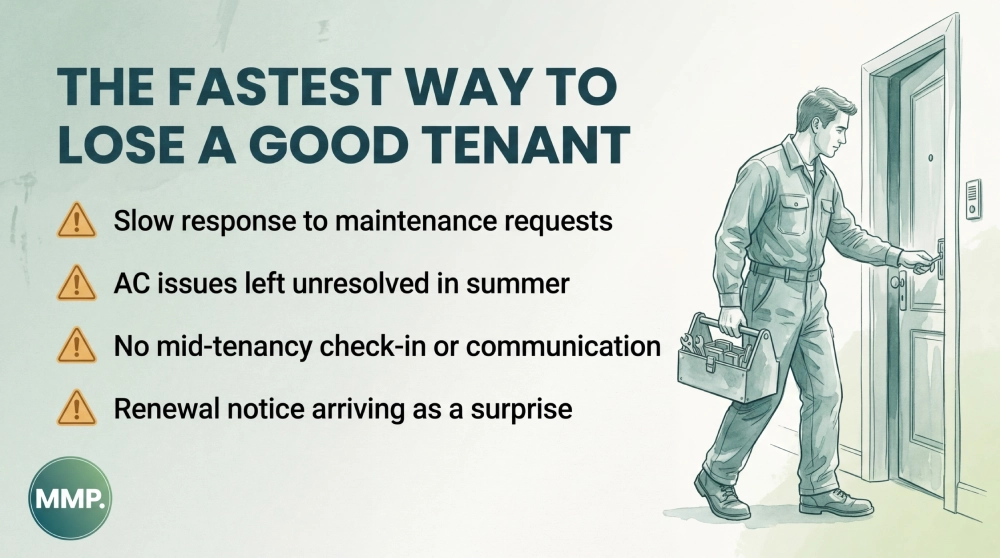
Specifically — maintenance that was slow, ignored, or handled reluctantly. A tenant who reports an AC problem in July and waits three weeks for a response is not just inconvenienced. They are quietly updating their opinion of their landlord. And when renewal comes around, that opinion influences their decision far more than the rent figure.
In Dubai’s climate, this carries particular weight. AC failures, water pressure issues, and DEWA-related problems are not minor inconveniences — they materially affect a tenant’s quality of life. Properties within walking distance of metro stations typically lease faster and retain tenants longer, but even a prime-location property will struggle to hold a good tenant if the basic operational experience is poor.
What good maintenance looks like in practice:
- Acknowledge every maintenance request within 24 hours — even if just to confirm it’s been received and a solution is coming
- Keep a network of trusted, responsive contractors rather than hunting for the cheapest option every time an issue arises
- Conduct a brief annual or mid-tenancy inspection — not to police the tenant, but to catch issues before they become expensive and to show you care about the condition of the property
- Communicate planned maintenance or building works in advance — tenants who feel informed feel respected
None of this is complicated. Most of it is simply being organised and reliable. Yet it is precisely what differentiates landlords whose tenants stay for five years from those who re-list every twelve months.
Make the Move-In Experience Count
First impressions in a tenancy work both ways. Tenants form an opinion of their landlord within the first few weeks of moving in — and that opinion is remarkably sticky. A landlord who hands over a clean, well-prepared property, responds promptly to early queries, and makes the move-in process smooth signals something important: this is someone who takes their investment seriously.
The practical checklist for a strong move-in:
- Deliver the property professionally cleaned, with all fixtures tested and functioning
- Prepare a clear, documented move-in condition report — with photographs — signed by both parties. This protects you, and it signals professionalism to the tenant
- Ensure the Ejari registration is completed promptly and the tenant has their copy
- Be available or have a responsive point of contact for the first two to four weeks, when most new tenants encounter small issues
- A simple welcome — even a brief note with emergency contact numbers and building information — costs nothing and sets the relationship on the right footing
A small detail that pays dividends: Tenants who receive a thorough move-in inspection and feel the process was handled professionally are significantly more likely to take better care of the property themselves throughout the tenancy. The signal you send at handover shapes how they inhabit the space. |
Communication That Doesn’t Disappear After the Contract Is Signed
One of the most reliable ways to lose a good tenant is to be completely absent between the contract signing and the renewal conversation. Many landlords have no contact with their tenant for eleven months and then suddenly appear with a rent increase proposal. It should not surprise anyone when that tenant decides to look elsewhere.
Keeping a good tenant is, at least in part, a relationship management exercise. That does not mean becoming their best friend. It means being the kind of landlord whose tenants feel they can raise a concern without anxiety, who communicates clearly when something affects the property, and who approaches renewal as a professional conversation rather than an ambush.
In practice, this looks like:
- A brief check-in message around the six-month mark — not intrusive, just present
- Giving at least 90 days’ notice if there will be any change to terms at renewal — legally required, but doing it early rather than at the last moment signals respect
- Being transparent about any planned works, building changes, or factors that might affect the tenant’s living experience
- When a tenant does raise an issue, responding with solutions rather than defensiveness
Dubai’s rental market in 2026 is one where quality tenants have more choices than they did two years ago. The landlords who compete successfully for their loyalty are those who make the tenancy experience feel managed and considered — not neglected until something goes wrong.
What This Looks Like at Scale
For landlords managing a single property from within Dubai, some of this is achievable without external support — with the right habits and the right contractors in place. For overseas landlords, or those managing multiple units, doing all of it consistently and to a professional standard is genuinely difficult.
This is the part of professional property management in Dubai that does not always make it into the headline — not just Ejari and rent collection, but the consistent, proactive management of the tenant relationship that keeps good tenants in place and bad situations from developing in the first place.
At Manage My Property, our certified property managers run the full cycle — from tenant screening and a professional move-in process through to mid-tenancy maintenance coordination and renewal benchmarking. The result is a 98% average occupancy rate across our managed portfolio. That is not luck. It is the compound effect of doing the small things right, consistently, over the life of each tenancy.
The Bottom Line
Great tenants are not a gift. They are the result of a property that is well-priced, well-maintained, and well-managed — and a landlord relationship that feels professional rather than indifferent.
In a Dubai market that is maturing and giving tenants real alternatives, the landlords who will consistently outperform are those who stop thinking about their tenancy as a transaction and start thinking about it as a relationship worth investing in.
The numbers are unambiguous: keeping a good tenant is almost always cheaper, easier, and more profitable than replacing one. Building the systems to make that happen — or partnering with someone who already has them — is one of the best decisions a Dubai landlord abroad or local investor can make. If you want to know how MMP approaches this for our clients, speak to a property manager today.
Keep Great Tenants. Grow Your Returns.