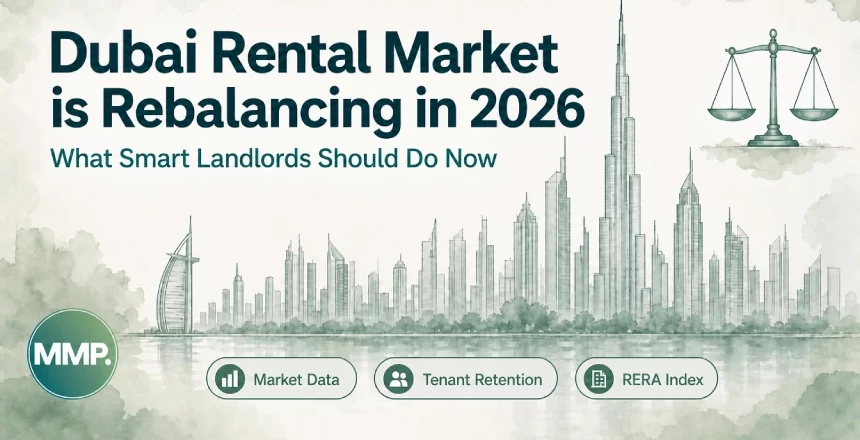
For the past two years, many Dubai landlords became used to rising rents, stronger renewals, and tenants competing for limited supply. Landlords renewed at higher numbers, new tenants paid premiums, and the question was never whether to raise rent — only by how much.
Reported market data showed average Dubai rents declining by around 6.7% between January-February and April 2026, with the correction most visible in apartment-heavy and prime communities. This is the first meaningful rental correction Dubai has seen since the post-pandemic recovery began.
If you own rental property in Dubai, this is the moment that separates landlords who manage strategically from those who manage on autopilot. This guide explains exactly what is happening, why, and what the right response is.
The one-line summary Rents are rebalancing, but demand is not collapsing — tenant enquiry volumes and contract numbers remain active. This is a pricing-power shift, not a demand collapse. The landlords who adjust their strategy now will outperform those who cling to peak-2024 expectations. |
What’s Actually Happening to Dubai Rents in 2026
The headline numbers tell a clear story, but the detail matters more. Here is what the data from the Dubai Land Department and major market analysts shows for early 2026:
- UAE-wide average rents fell approximately 5.4% between January–February and April 2026
- Dubai specifically recorded a drop of around 6.7% over the same period
- Prime areas were hit hardest — Downtown, Palm Jumeirah and JLT saw declines of roughly 10-15%
- New-contract prices fell faster than renewals — median new apartment rent dropped from about AED 78,000 in February to AED 70,000 in April
- Crucially, demand held: April rental contract volumes were up around 16% year-on-year
That last point is the most important. This is not a situation where tenants have disappeared. People still need homes — Dubai’s population continues to grow and a large share of residents rent. What has changed is the balance of pricing power. Tenants now have more choice, are comparing more listings, and are negotiating harder.
Which Areas Are Softening Most
The correction is not uniform. It is concentrated in specific segments — primarily apartment-heavy communities where new supply has entered the market. Here is the area-by-area picture for early 2026:
Area | Rent Movement (early 2026) | Segment |
Downtown Dubai | Down ~ 10-15% | Prime apartments |
Palm Jumeirah | Down ~ 10-15% | Prime / waterfront |
Jumeirah Lake Towers (JLT) | Down ~ 10-15% | Mid-high apartments |
Jumeirah Village Circle (JVC) | Down ~ 5-10% | Mid-market apartments |
Jumeirah Beach Residence (JBR) | Down ~ 5-10% | Mid-high apartments |
Dubai Silicon Oasis | Softening | Budget-mid (new supply) |
Arjan / Sports City | Softening | Mid-market (new supply) |
Established villa communities | Holding firmer | Villas / townhouses |
The pattern is clear: apartment-heavy communities with significant new supply are softening most, while established villa communities with constrained supply are holding firmer. This is a supply-driven adjustment, not a demand-driven collapse. Areas like JVC, Arjan, Dubai Silicon Oasis and Sports City are easing because a large volume of new stock has become available — giving tenants more choice and negotiating power.
Why This Is Happening — The Three Forces at Work
Understanding the cause matters, because it tells you whether this is a temporary dip or a structural shift. Three forces are driving the current softening:
Force 1: New Supply
This is the dominant factor. A very large pipeline of apartments is delivering completed homes into the market. As supply rises, tenants gain choice, and pricing power shifts away from landlords. The apartment segment is most affected because that is where the supply pipeline is heaviest.
Force 2: Market Normalisation
The double-digit rent increases of 2023–2024 were never sustainable. They priced out tenants and created pressure that had to release eventually. What’s happening now is the market finding a more rational equilibrium — a maturing market, not a breaking one. Year-on-year rent growth had already decelerated to 4–6% before the recent declines.
Force 3: Short-Term Confidence and Sentiment
Early 2026 created a temporary confidence shock, accelerating the correction in the first quarter. Short-term and holiday rentals were hit hardest. Long-term residential demand, protected by Ejari contracts and the RERA framework, remained structurally intact — existing tenants on valid contracts could not be subjected to sudden rent changes mid-lease.
Why the RERA framework matters right now Dubai’s Smart Rental Index means rent changes are benchmarked to actual market data, not landlord discretion or short-term sentiment. In a softening market this cuts both ways: it protects landlords from panic-driven tenant demands for reductions, while also preventing increases the market no longer supports. Knowing exactly where your property sits on the index is more valuable now than at any point in the last three years. |
What Smart Landlords Are Doing — and What’s Costing Others Money
In a softening market, the gap between good and poor property management becomes financially visible. Here is the practical divide:
✓ What Smart Landlords Are Doing | ❌ What’s Costing Landlords Money |
Prioritising tenant retention over headline rent | Pushing maximum increases and losing good tenants |
Pricing renewals against current market, not peak 2024 | Anchoring to peak-year rents the market no longer supports |
Reletting fast at market rate when a unit goes vacant | Holding out for an unrealistic rent while the unit sits empty |
Investing in presentation and maintenance to compete | Letting condition slip while expecting premium rent |
Responding quickly to enquiries and viewings | Slow responses in a market with fewer enquiries per listing |
Using RERA index data to justify any increase | Proposing increases the index doesn’t legally support |
The single biggest mistake in the current market is treating tenant retention as optional. When rents were rising, a landlord could lose a tenant and relet at a higher rate within days. That math has reversed. With new-contract prices falling toward renewal prices, the financial upside of losing a good tenant and finding a new one has shrunk dramatically — while the cost of a vacant unit has stayed the same.
The Tenant Retention Calculation
Let’s make this concrete. Consider a one-bedroom apartment that rented for AED 80,000 at peak. Here is the decision a landlord faces at renewal in the current market:
Scenario A: Push for a maximum increase
The landlord pushes the rent up, the tenant — now with more options and negotiating power — declines and leaves. The unit goes vacant. In the current market it takes longer to relet, and the new contract rate is lower than it would have been a year ago. Result: one to two months of vacancy (AED 6,600–13,300 in lost rent) plus a new tenant likely paying less than the previous one, plus releasing costs.
Scenario B: Retain the tenant at a measured rate
The landlord prices the renewal sensibly against current market conditions, the tenant stays, and the unit never goes vacant. The headline rent may be marginally lower, but the property generates uninterrupted income with no vacancy gap, no releasing costs, and no risk of a worse new-contract rate.
In a rising market, Scenario A often won. In the current market, Scenario B almost always wins. The landlords who understand this are protecting their income. The ones still operating on 2024 assumptions are losing money while believing they are maximising it.
The retention advantage long-term tenants give you Because of RERA caps, many tenants who have been in place since 2020–2021 are still paying below today’s open-market rent — even after the recent softening. If you have a long-term tenant, your position is stronger than the headlines suggest. You may reasonably be able to hold rent or even apply a modest index-supported increase, while a landlord with a tenant who signed at peak faces real downward pressure. |
The Five Moves That Protect Your Income in a Softening Market
If you own rental property in Dubai right now, these are the practical actions that matter most:
- Check your property against the current RERA Smart Rental Index — not last year’s number. Know exactly where you stand before any renewal conversation.
- Prioritise retaining good tenants. A reliable tenant in place is worth more than a marginally higher rent with vacancy risk.
- If a unit does go vacant, price it to the current market and relet fast. Do not chase a peak-year rent while the unit sits empty.
- Invest in presentation and maintenance. In a competitive market, condition is what wins the tenant — well-maintained units let faster and hold rent better.
- Respond fast. With fewer enquiries per listing, every enquiry matters more. Slow responses lose tenants to more responsive landlords.
Every one of these moves is part of what professional property management delivers as standard. Professional property management in Dubai means having a certified manager who tracks the RERA index, manages renewals strategically, relets vacant units quickly at market rate, and keeps your property in the condition that wins tenants in a competitive market.
Why a Softening Market Is When Management Matters Most
It is easy to manage a property well when rents only rise. Mistakes get hidden by the market — a slow relet still results in a higher rent, a lost tenant is quickly replaced at a premium. A rising market forgives poor management.
A softening market does not. Every week of vacancy is a real loss. Every tenant lost to a clumsy renewal is expensive to replace. Every unit priced above market sits empty while better-managed properties around it get let. This is precisely the environment where the difference between professional management and self-management shows up directly in your bank account.
MMP’s approach is built for exactly this. Rental income management focuses on protecting and optimising your actual yield — not chasing headline rents. Tenant screening and retention keeps reliable tenants in place. And when issues arise, structured lease enforcement protects your position. The full picture is in our complete property management service.
The Bottom Line
Dubai’s rental market in 2026 is rebalancing after two years of exceptional growth. Rents are softening in many apartment communities, demand is holding, and pricing power has shifted toward tenants. This is not a market to fear — it is a market to be strategic in.
The landlords who will come through this period strongest are those who price realistically, retain good tenants, relet quickly, and treat their property as a managed financial asset rather than an automatic income stream. The ones who struggle will be those still anchored to peak-year expectations, pushing increases the market won’t bear, and absorbing vacancy costs they could have avoided.
If you want a clear, honest assessment of where your specific property sits in the current market — and what the right strategy is for your next renewal — Manage My Property has been guiding Dubai landlords through every market cycle since 2007.
Not sure how the softening market affects your property? MMP’s certified property managers will give you a straight assessment — where your property sits on the RERA index, what your renewal strategy should be, and how to protect your income in the current market. |