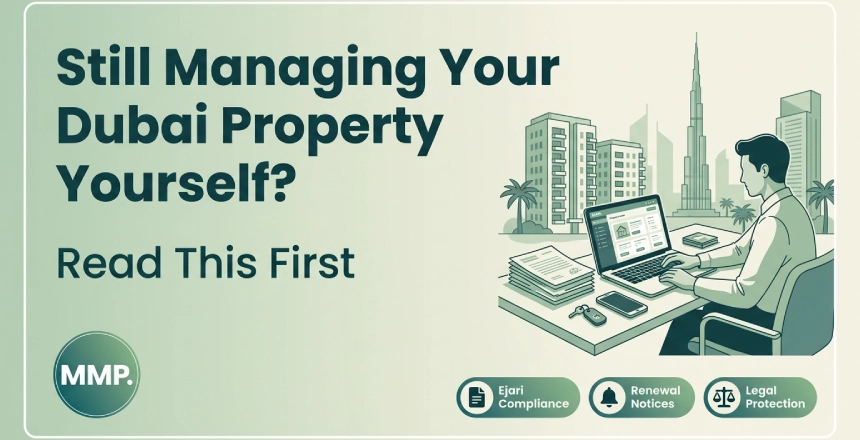
There is a particular type of landlord who discovers property management the hard way.
They own an apartment in Dubai. They manage it themselves because they are capable adults who send emails and negotiate contracts and do not see why they should pay anyone to do something they are perfectly capable of handling. The arrangement works fine for a while. The tenant pays. The boiler behaves. Life continues.
Then something happens.
It does not have to be a war — though as of March 2026, there is one reshaping headlines across the region. It could be a job change that takes you abroad. A market shift that affects tenant demand. A maintenance emergency at 2am. A renewal negotiation that stalls because you and the tenant cannot agree on a new figure and neither of you knows what the RERA Rental Index actually says.
The point is this: uncertainty — regional, personal, or otherwise — has a way of finding every gap in a passive arrangement. And right now, the gap most Dubai landlords are sitting with is that their investment is running on autopilot while the landscape around it is anything but. This is exactly the moment when property management in Dubai stops being a convenience and starts being a necessity.
This is not an article designed to make you anxious. It is an article designed to make you practical.
1. What Uncertainty Actually Does to a Property Market
Dubai has a well-established pattern when regional or global events create turbulence: transactions slow, sentiment pauses, and then the city absorbs the shock and moves on. It has done this repeatedly — through the 2008 financial crisis, through COVID-19, through multiple episodes of regional tension.
The current situation is no different in structure, even if the specifics are their own. Dubai recorded AED 917 billion in real estate transactions in 2025 — the highest in its history — and the structural drivers that produced those numbers have not changed. A population that crossed 4 million. Zero income tax. Rental yields in many mid-market residential segments range between roughly 6% and 9%, depending on location and property type. One of the world’s most investor-friendly residency frameworks.
What does change, in a period of uncertainty, is behaviour. Buyers pause. Some sellers become motivated. Tenants who were thinking of leaving extend their leases because moving feels like one more thing to navigate. Decision-making slows.
For a property owner, this creates a specific challenge: the market is not broken, but it requires more attention, not less. Renewal negotiations become more delicate. Tenants become more likely to push back on rent increases. Vacancy — if it occurs — becomes more expensive to absorb because finding a replacement tenant in a cautious market takes longer.
The data point worth knowing: Dubai recorded AED 917 billion in real estate transactions in 2025 — the highest in its history, across more than 270,000 deals. Source: Dubai Land Department. That structural foundation has not changed. What has changed is that the market now rewards careful management over passive ownership. |
2. The Landlord Abroad Problem
A significant proportion of Dubai property owners do not live in Dubai. They bought as an investment, a second home, a hedge, a pension plan, or all four simultaneously. They have a tenant. They receive rent. They have a WhatsApp group with one member: their building’s maintenance number, used rarely.
This arrangement works perfectly until it does not.
In a period of uncertainty, the ‘does not’ arrives faster. Your tenant’s company is reassessing its regional footprint. They want to break the lease early, or they are asking about a rent reduction to stay, or they have gone quiet in a way that suggests neither of these conversations has quite started yet. Your Ejari is due for renewal. There is a maintenance issue the tenant flagged two weeks ago and you have not had a chance to organise a contractor.
None of these are catastrophic individually. Together, mismanaged from four time zones away, they are the definition of an expensive problem. Not expensive because of the crisis — but expensive because of the gap between what the situation requires and the attention it is actually receiving.
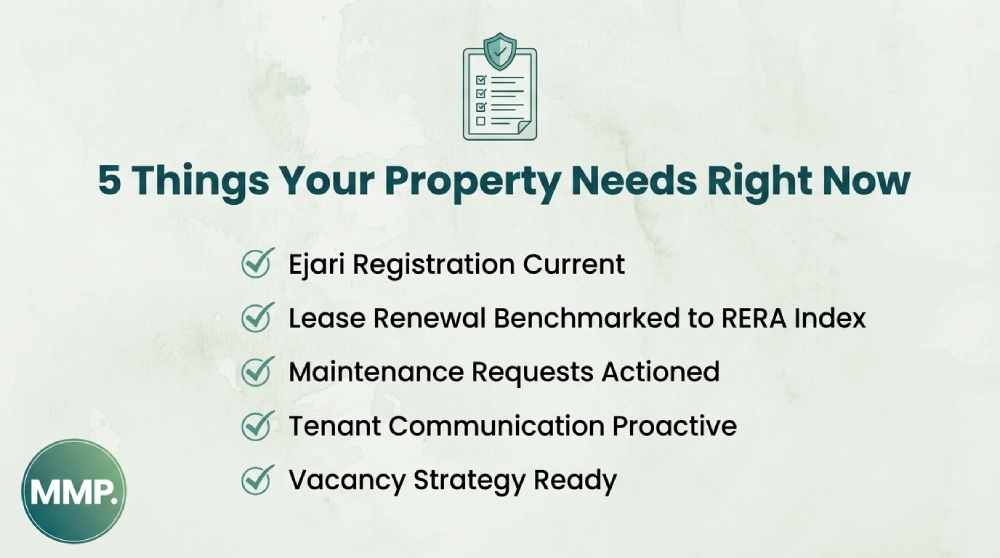
A professional property manager with dedicated responsibility for your asset does not have a timezone. The maintenance call gets answered. The renewal conversation happens proactively, benchmarked against the actual RERA Rental Index, before the tenant starts looking elsewhere. The Ejari is current. The tenancy contract is airtight. When something unexpected happens, you receive a phone call explaining what is already being done — not a WhatsApp message at midnight telling you there is a problem.
3. Why Uncertain Markets Reward the Prepared Landlord
Here is the counterintuitive part. While uncertainty discourages buyers, it often benefits well-managed rental properties. Tenants who were considering purchasing hold off. Professionals who have relocated to Dubai for work — and there are many, because Dubai continues to attract them regardless of regional headlines — still need somewhere to live, and they need it managed properly.
The landlords who benefit during these periods are not the ones with the best properties. They are the ones whose properties are well-maintained, correctly priced against the current market, and managed by someone with the knowledge and presence to handle what comes.
Historically, every period of Dubai market slowdown has been followed by a recovery that outpaced the dip. The investors who sat out the uncertainty to ‘wait and see’ consistently underperformed those who held their positions and managed them actively. The same dynamic applies to rental landlords: the ones who take this moment to put professional management in place are better positioned for the rebound than those who let uncertainty be an excuse for inaction.
A practical note on yields: Dubai rental yields remain among the most competitive of any major global city — a fact consistently confirmed by the DLD’s own market data. The question is not whether your asset is generating returns. It is whether those returns are being protected by someone who knows what they are doing. |
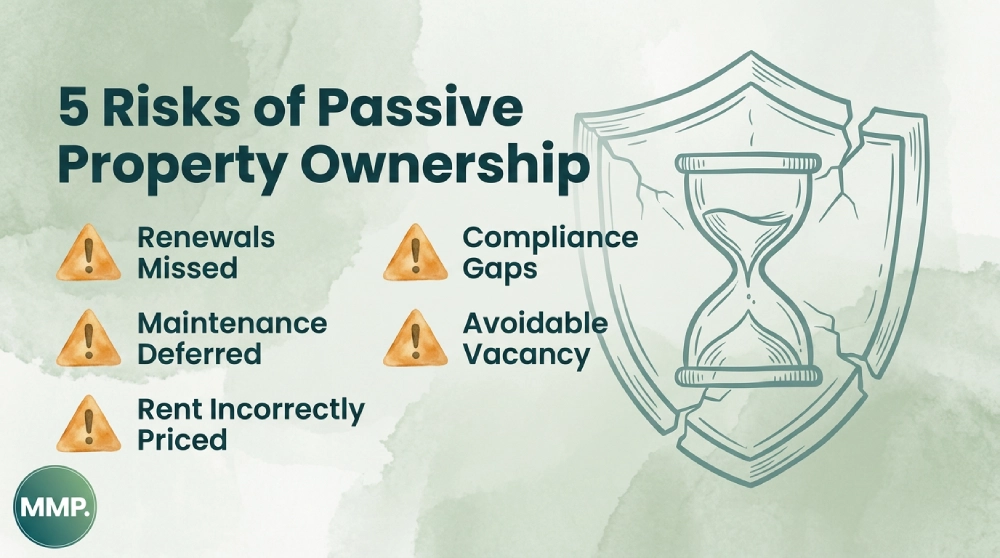
4. The Five Things That Happen to Unmanaged Properties During Uncertain Periods
This is not a list of worst-case scenarios. It is a list of ordinary, predictable outcomes that occur when a property is managed passively during a period when the market requires active attention.
- Renewals are handled too slowly
A tenant whose lease is expiring will make a decision about whether to renew based on the conversation they have — or do not have — in the weeks before the deadline. A proactive renewal offer, benchmarked correctly against the market, retains good tenants. An owner who misses the window because they were busy or distracted loses a tenant who would have stayed, and then spends several months and a great deal of effort finding a new one in a cautious market.
- Maintenance deferred becomes maintenance expensive
A minor issue addressed immediately costs a fraction of the same issue addressed after three months of polite waiting. Tenants who feel their maintenance requests are being ignored become tenants who leave. Or tenants who stop paying. Neither outcome is better than fixing the boiler.
- Mispriced rental rates
The RERA Rental Index Dubai moves with the market. An owner who prices a renewal based on what they charged in 2024 rather than what the index supports in 2026 is either leaving money on the table or triggering a dispute they did not need. A property manager who works with this data every day does not make this mistake.
- Compliance gaps
Ejari registrations lapse. Contract renewals are handled informally. Notice periods are served incorrectly. Each of these is a small thing until it is not. An incorrectly registered tenancy undermines your standing at the RDC if a dispute arises. A poorly served notice resets your legal timeline and costs you a month you cannot get back. These are not exotic risks. They are the ordinary result of managing a legal arrangement without professional attention.
- The vacancy that could have been avoided
A well-managed property rarely becomes vacant unexpectedly. Good tenant relationships, timely communication, fair renewal terms, and a maintained physical asset are the reasons tenants stay rather than leave. Vacancy is not random. It is, in most cases, the predictable outcome of management that was not attentive enough at the moments that mattered.
5. This Is Not a New Argument. It Is a Timely One.
Professional property management in Dubai has always made sense. The case for it does not depend on external events. It depends on the simple reality that managing a rental property properly is a full-time job — and most landlords already have one of those.
What changes in a period like this is the cost of getting it wrong. In a booming, frictionless market, mistakes are absorbed by momentum. In a market that requires more precision, they are not.
At Manage My Property, we manage Dubai properties for landlords who are present and those who are not. We handle renewals before they become problems. We manage maintenance before it becomes expensive. We keep Ejari current and tenancy contracts airtight. We benchmark every renewal against the RERA Rental Index so that your asking price is defensible and correct. We have a dedicated manager assigned to your property — someone who knows your asset, your tenant, and your history. Not a call centre. Not whoever is free that day.
If the current moment has made you think about what your property is doing without you — that thought is worth acting on.
The honest framing: Professional property management is not a cost. It is the difference between a Dubai property that generates income and one that generates stress. In a market this capable of returning strong yields, the landlords who protect those yields are the ones who treat the asset professionally. The ones who do not are the ones who call us when something has already gone wrong. |
The Bottom Line
Dubai’s property market has survived every shock thrown at it and emerged with stronger fundamentals each time. It will do so again. The question is not whether your investment is safe — structurally, it almost certainly is. The question is whether it is being managed well enough to take full advantage of what comes next.
The landlords who come out of uncertain periods ahead are not the ones who worried most. They are the ones who made sure the basics were handled by someone who does them every day.
Your property does not take days off. The person responsible for it probably should not either.
Manage My Property provides dedicated, professional property management in Dubai — for landlords who are here, and those who are not.
Speak to an MMP Property Manager today and learn how professional management protects your rental income, tenant relationships, and legal compliance: wa.me/971581177638