Everyone hears the same story.
“My neighbour listed his flat on Airbnb and made double what I do on a long-term lease.”
And honestly – In the best-case scenario, with the right apartment, the right location, the right timing, and a full-time operational set-up behind it, that can happen.
But here is the part nobody tells you: that best-case scenario is just an exception, not the rule.
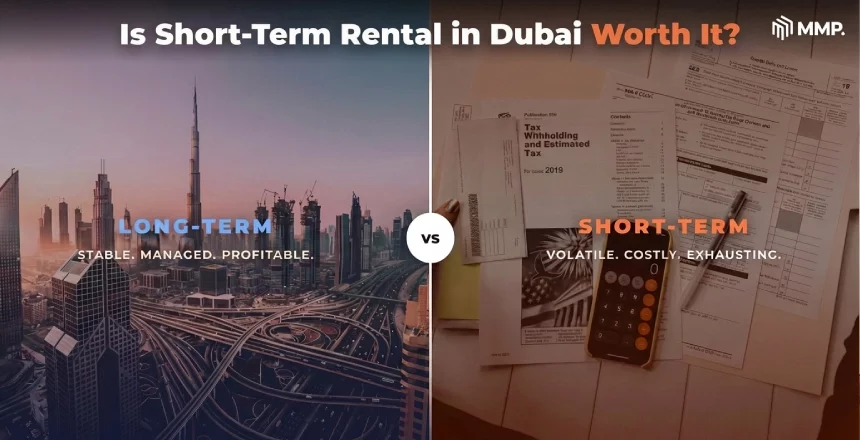
For the vast majority of Dubai property owners, short-term rental is not a viable strategy. It is a part-time job disguised as passive income.
Let us break down exactly why.
1. The Regulatory Burden Is Real and It Is Growing
Short-term rentals in Dubai are not simply a matter of listing your flat and letting guests in.
The regulatory framework is serious, multi-layered, and unforgiving.
Before a single guest checks in, you need:
- A Holiday Home permit from the Department of Economy and Tourism (DET), issued per unit and renewed annually.
- A valid DTCM registration with full documentation including title deed and DEWA bills.
- A property that has passed physical inspection and meets classification standards.
- Guest reporting logged into the DET system after every stay.
- Monthly Tourism Dirham remittance of AED 10 to 15 per room per night, collected from guests and reported to government.
Miss any one of these and you are looking at fines, permit suspension, or outright revocation.
And that is before you consider that individual buildings and Owners’ Associations in areas like Downtown Dubai, Business Bay, JBR, and Dubai Marina may have their own internal bans on short-term rentals, even if DET has approved you. Building management has the legal authority to shut you down regardless of your government permit.
The reality: Short-term rental compliance in Dubai is essentially a regulatory second job. The DTCM permit alone involves registration fees plus per-unit permit fees depending on property size, all paid upfront before your first booking.
2. The “Higher Yield” Promise Comes With Hidden Costs Nobody Mentions
Yes, the top 10% of Dubai Airbnb listings can achieve higher occupancy rates and generate acceptable returns. But the keyword is top 10%.
The average occupancy rate for an Airbnb in Dubai sits at approximately 44%. That means your apartment sits empty more than half the year.
Now factor in the actual minimum cost structure of running a short-term rental properly:
Cost Item | Estimated Annual Impact |
|---|---|
DET/DTCM permit & renewal | AED 2,000 to 3,000+ per unit |
Professional cleaning after every checkout | AED 250 to 500 per clean |
Linen, toiletries and consumables | AED 5,000 to 10,000 per year |
Furniture wear and replacement | Significantly higher than long-term |
Utility bills (DEWA, internet) | Paid by owner, not tenant |
Platform commission (Airbnb/Booking.com) | 15 to 20% of gross revenue |
STR property management (if outsourced) | 20 to 30% of revenue |
Marketing, photography, listing optimisation | AED 3,000 to 8,000 per year |
Once you run these numbers honestly, the net yield on a short-term rental is frequently lower than a well-managed long-term tenancy, particularly outside peak tourist seasons.
Expert Tip: Dubai’s STR market has extreme seasonality. December is peak season. August is the slow season. Between the two, revenue swings dramatically. A long-term annual lease gives you fixed, predictable income regardless of whether it is Ramadan, summer, or a slow tourism month.
3. It Is Not Passive Income. It Is an Operation
Let us be completely clear about what managing a short-term rental actually involves:
- Guest communication before, during, and after every stay, often at all hours
- Check-in and check-out coordination, frequently on the same day
- Cleaning management, including booking, supervising, and quality-checking after every departure
- Damage assessment, since every guest is a new risk to your furniture, fixtures, and appliances
- Maintenance callouts, which arise constantly with high turnover properties
- Review management, because a single bad review can seriously damage your occupancy rate
- Dynamic pricing, as rates must be adjusted constantly to stay competitive
- Compliance monitoring across DET records, Tourism Dirham submissions, and building policy updates
This is not passive income. This is a hospitality business.
If you outsource it to an STR management company, you will typically pay 20 to 30% of gross revenue, which erodes your returns significantly. If you manage it yourself, you are effectively working a part-time job on top of your career, with no guaranteed income.
Compare that to a long-term lease managed professionally by a RERA-certified asset manager, where 98% or higher occupancy rates are achievable and the management fee is just 7% of annual rent. A fraction of the cost, for a fraction of the stress. To top that, the management fee, since it is charged as a % of your rent, you pay the fee only when your property is rented and not sitting idle.
4. Liability, Insurance and Legal Exposure Is Underestimated
Most standard home insurance policies in Dubai do not cover short-term rental activity. If a guest damages your property, causes a flood affecting the floor below, or is injured on your premises, you may have no coverage at all.
Add to that:
- Data protection obligations under UAE Federal Decree-Law No. 45 of 2021. You are required to collect, store, and report guest data responsibly. Non-compliance carries penalties.
- Liability for guest conduct. If guests violate building rules, disturb neighbours, or host unauthorised gatherings, the consequences come back to the property owner.
- NOC requirements. Tenants who wish to list a property short-term need landlord approval. Without it, the host risks losing the right to operate entirely.
Long-term rental under RERA’s framework, by contrast, gives you a legally binding Ejari contract, clear rights and obligations for both parties, and access to the Rental Dispute Centre if anything goes wrong.
5. Global Uncertainty Is Quietly Reshaping Tourism Demand
There is something else that does not appear in any Airbnb revenue calculator, but that every experienced investor in this region understands: tourism is sensitive to the world around it.
Over the past two years, sustained geopolitical tensions across the broader Middle East region have introduced a layer of unpredictability into international travel patterns that simply did not exist before. When travellers perceive instability in a region, even when the destination itself is entirely safe and operating normally, booking confidence softens. Flight routes are adjusted. Corporate travel policies tighten. High-spending visitors from certain markets choose alternative destinations.
Dubai has proven remarkably resilient, and continues to attract millions of visitors each year. That resilience, however, is built on its status as a global business hub, a long-term residential destination, and a city with a stable professional population. It is not built on the same short-term tourism spikes that drive Airbnb occupancy in leisure-first destinations.
The landlords who are most exposed to this uncertainty are precisely those relying on short-term tourist bookings. A week of reduced international arrivals, a slow corporate travel month, or a temporary dip in bookings from a key source market can erase a month of STR profitability in a city where operating costs are already high.
Long-term residential tenants, by contrast, are not booked through an app and they are not affected by international flight confidence. They are professionals, families, and business people who have chosen Dubai as their base. That demand is structural. And it is the kind of demand that a professionally managed property can capture and hold consistently.
The bottom line on this point: predictable income from a stable resident tenant will always outperform volatile income from tourist bookings in periods of global uncertainty. And in 2026, that uncertainty is not going away.
6. The Dubai STR Market Is Not What It Was in 2019
Short-term rental returns in Dubai peaked during a period of limited supply and surging post-COVID tourism. That window has narrowed considerably.
Today, Dubai’s STR market has over 57,000+ active listings competing for the same tourist pool. Supply has grown faster than demand in many segments. The result is lower occupancy, more aggressive pricing pressure, and a race to the bottom on nightly rates in all but the most premium locations.
Meanwhile, long-term rental demand is at an all-time high in 2026. Dubai’s growing resident population, the expansion of business districts, and a wave of remote workers and global professionals choosing Dubai as their base have created sustained, structurally strong demand for quality long-term tenancies.
Rental yields of 6 to 8%, and up to 10% in emerging areas, are entirely achievable through long-term leasing without the operational complexity, seasonality risk, or regulatory overhead of the holiday homes market.
7. The Only Situation Where Short-Term Rental Makes Sense
To be fair, there are scenarios where an STR strategy can work:
- A prime location property on Palm Jumeirah, Downtown Dubai, or JBR, with genuinely premium finishes
- A professionally managed operation with dedicated STR specialists handling everything
- An owner who does not need predictable monthly income and can absorb slow seasons
- A property that has obtained full building and DET approval without restrictions
Even in these cases, you are still looking at a complex, high-maintenance operation that requires expert management to be profitable.
For the overwhelming majority of Dubai property investors, particularly those overseas, managing multiple assets, or simply looking for reliable passive income, long-term rental with professional asset management is the smarter, more sustainable, and ultimately more profitable choice.
The Bottom Line
Short-term rental is not a set-it-and-forget-it strategy. It is a regulated hospitality operation that requires time, expertise, compliance infrastructure, and consistent effort to generate returns. And even then, the numbers often do not beat a well-optimised long-term lease.
At MMP (Manage My Property), we have seen landlords pivot away from short-term models after experiencing the reality first-hand. The consistent feedback is the same every time: “I wish I had just done this properly from the start.”
If you want your Dubai property to generate reliable, legally compliant, genuinely passive income, the answer is professional long-term asset management. And that is exactly what we are built to deliver.
Speak to an MMP Property Manager today: wa.me/971581177638
Frequently Asked Questions
Is short-term rental legal in Dubai?
Yes, but it requires a Holiday Home permit from the Department of Economy and Tourism (DET), DTCM registration, and compliance with guest reporting and Tourism Dirham obligations. Individual buildings — especially in Downtown Dubai, Business Bay, and Dubai Marina — may ban short-term rentals independently of government permits.
What is the average occupancy rate for Airbnb in Dubai?
The average occupancy rate for short-term rentals in Dubai is approximately 44%, meaning properties sit empty more than half the year on average. Only the top 10% of listings — typically prime locations on Palm Jumeirah, Downtown, or JBR with professional management — consistently outperform a well-managed long-term tenancy.
Is short-term rental more profitable than long-term rental in Dubai?
Not for most landlords. Once you account for DET permit fees, platform commissions of 15–20%, professional cleaning after every checkout, utility bills, furniture wear, and STR management fees of 20–30% of revenue, net yields frequently fall below what a well-managed long-term lease delivers — without the operational stress.
What are the risks of short-term rental in Dubai?
Key risks include regulatory non-compliance fines, building management bans, gaps in standard home insurance coverage, liability for guest conduct, Tourism Dirham reporting obligations, and income volatility driven by seasonality and tourism fluctuations. Long-term leasing under RERA’s framework provides significantly more legal protection and income predictability.
What rental yield can I expect from long-term rental in Dubai in 2026?
Long-term rental yields of 6–8% are consistently achievable across Dubai, with up to 10% in emerging areas — without the operational complexity of short-term rental. With a professionally managed tenancy, occupancy rates of 98% or higher are realistic, compared to the 44% average for Dubai Airbnb listings.
Can my tenant list my property on Airbnb without my permission?
No. Tenants require the landlord’s written approval (NOC) to list a property as a short-term rental. Without it, the host risks losing their permit entirely. As the property owner, you are also ultimately liable for regulatory breaches — even if it was the tenant operating the listing.