- 6 min read
Good for you. Seriously.
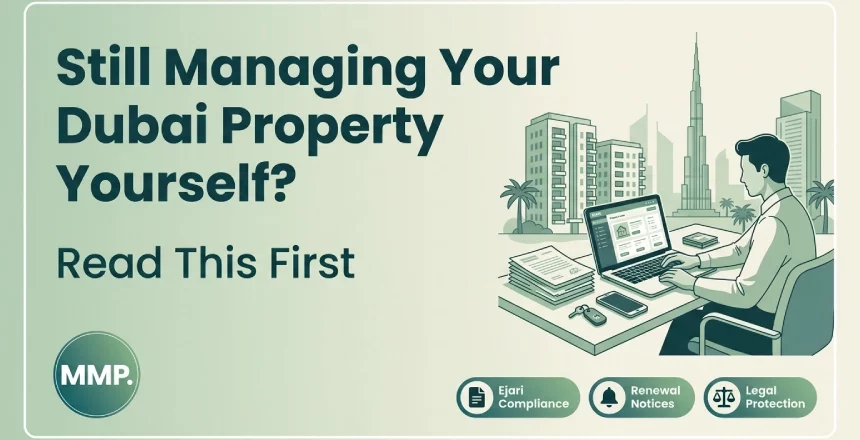
Self-managing a Dubai rental property takes effort, organisation, and a reasonable working knowledge of a regulatory environment that most people would rather not engage with at all. If you have been doing it and it has been working, that is not nothing.
But here is the thing about self-management that tends to catch landlords off guard: it works right up until it doesn’t. And the moment it stops working is rarely a gentle, gradual decline. It is usually a specific situation — a non-paying tenant, a disputed renewal, a maintenance issue that escalated, an Ejari that lapsed without anyone noticing — that suddenly requires knowledge, documentation, and legal standing that was never quite put in place.
This article is not an argument that self-management is wrong. It is a checklist of the things that self-managing landlords most commonly get wrong — and an honest look at what the gap actually costs when it matters.
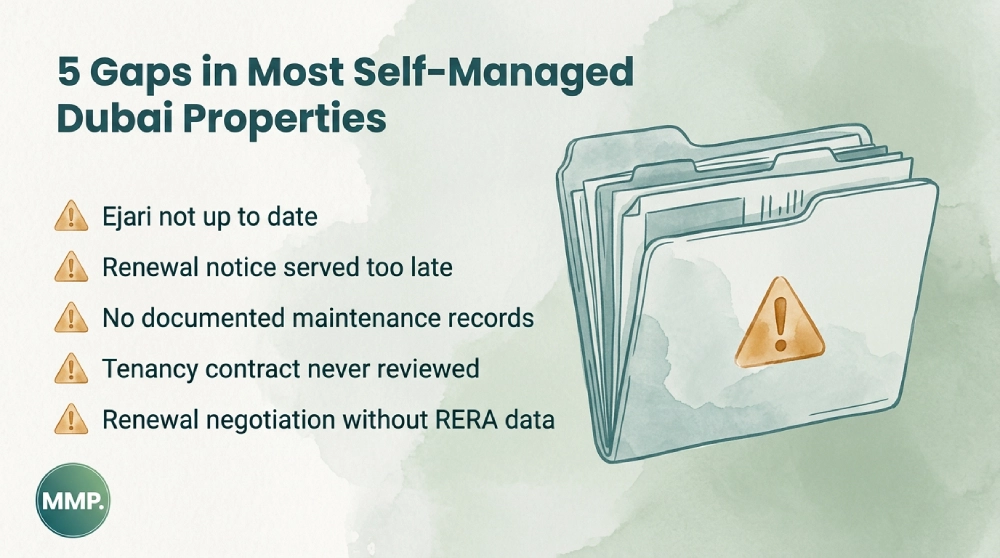
The Five Things Most Self-Managing Landlords Have Not Quite Sorted
These are not exotic edge cases. They are the ordinary, recurring gaps in how most Dubai landlords handle their own properties — identified consistently through the situations that end up at the Rental Disputes Centre, or that land on the desk of a property manager as a crisis rather than a routine.
- The Ejari that is almost current
Ejari registration is mandatory for every tenancy in Dubai. Without a registered, current Ejari contract, your tenancy has no legal standing. You cannot file at the Rental Disputes Centre. Your tenant cannot transfer DEWA into their name, apply for a residency visa, or use the property for any purpose that requires proof of legal tenancy.
Most self-managing landlords know this. The problem is not ignorance — it is timing. Ejari renewals are tied to contract end dates, and self-managing landlords who are juggling other priorities occasionally let them slip. A lapsed Ejari is not a minor oversight. It is the legal foundation of the tenancy, and everything built on it is compromised until it is sorted.
When did you last check that yours is current? Not approximately current. Actually confirmed, with the certificate in hand.
- The renewal notice that was served too late — or not at all
Dubai tenancy law requires that any rent increase be notified to the tenant in writing, at least 90 days before the contract end date. This is not a guideline. It is a legal requirement. A notice served at 80 days, or 60 days, or informally via WhatsApp with the right spirit but the wrong format, is not a valid notice. The landlord loses the right to a rent increase at that renewal cycle. Full stop.
The RERA Rental Index Dubai determines how much you can legitimately ask for. If the index supports a 10% increase but you served notice 60 days before renewal, you are getting zero for that year. One missed window on a property renting for AED 80,000 is AED 8,000 gone. On a property at AED 150,000, it is AED 15,000. These are not theoretical losses.
The 90-day rule in plain language: Written notice, served 90 days or more before contract expiry, by legally valid method (not WhatsApp), stating the proposed new rent and the index basis for it. Miss any part of that, and the increase does not apply. Dubai’s Rental Disputes Centre applies this consistently. |
- The maintenance arrangement that has no paper trail
Something breaks. You call someone. They fix it. The tenant is happy. You pay the invoice. Great.
Now, six months later, that same tenant is disputing their security deposit deduction, claiming the damage was pre-existing. Or they are at the RDC arguing that you failed your maintenance obligations under the tenancy contract. Do you have a documented move-in inspection report? A signed inventory? A maintenance log with dates, issues, and resolutions?
Disputes over property condition are among the most common landlord-tenant conflicts in Dubai. The landlord who wins them is the one with documentation. The landlord who loses them is the one who kept everything in their head and their WhatsApp.
- The tenancy contract that was never quite reviewed
Many self-managing landlords use a standard tenancy template, sign it, and file it away. The problem is in the details: maintenance responsibility thresholds, early termination clauses, notice periods, subletting provisions, and what happens to the deposit in specific scenarios. A vague or incomplete contract is not a protection — it is an invitation to a dispute where both parties have a reasonable argument.
When did you last actually read your tenancy contract? Not the summary. The document itself, clause by clause.
- The renewal that became a negotiation they were not prepared for
Dubai’s 2026 rental market is more tenant-savvy than it has ever been. The Smart Rental Index is publicly accessible, free to use, and tells tenants exactly what a landlord is and is not permitted to ask for. Tenants who know this arrive at renewal conversations prepared. Self-managing landlords who have not run the same calculation, who are proposing an increase based on instinct or hearsay, walk into that conversation at a disadvantage.
The result is either an increase below what the index would have supported, a conflict that damages the tenancy relationship, or both.
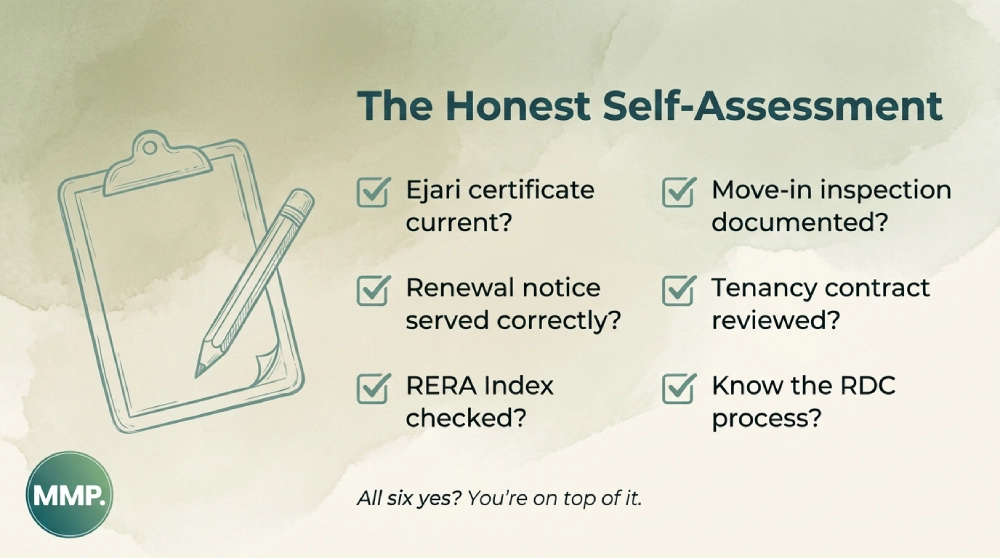
The Honest Self-Assessment
Here is a quick diagnostic. Answer these questions as honestly as you would answer them if someone else were checking your answers.
- Is your Ejari certificate current, and can you produce it right now?
- Have you served written renewal notice within the last or current cycle, at least 90 days before expiry, in a legally valid format?
- Have you run the RERA Rental Index Dubai calculation for your unit and know what increase you are entitled to ask for?
- Do you have a documented move-in inspection report with photographs, signed by you and your tenant?
- Can you locate your tenancy contract and point to the clause covering early termination notice?
- If your tenant stopped paying rent today, do you know the exact legal process, the correct notice format, and the filing requirements at the Rental Disputes Centre?
If all six are yes, with documentation — you are genuinely on top of it. Carry on.
If any of those gave you a moment of honest uncertainty, that uncertainty is the answer. Not because the gap is catastrophic today, but because it will be if the situation ever requires it to not be.
The pattern worth recognising: Self-managing landlords rarely discover they have a problem during easy periods. They discover it when a tenant stops paying, when a renewal turns difficult, when a deposit dispute goes to the RDC, or when a maintenance liability becomes contested. Those are exactly the moments when the documentation, the process, and the legal standing either hold up or they do not. |
What Professional Property Management in Dubai Actually Handles
The question most self-managing landlords ask is what they would be paying for. It is a fair question, and it deserves a specific answer rather than a list of vague benefits.
A dedicated property manager handling your Dubai rental property management takes ownership of the following, systematically, without being prompted:
- Ejari registration at the start of each tenancy, renewal at contract end, and maintenance throughout
- Renewal notices served in writing, 90 days in advance, with the RERA Rental Index calculation attached
- Documented move-in and move-out inspections with photographic records
- Maintenance coordination with a vetted contractor network — actioned quickly, documented properly
- Rent collection, payment records, and financial reporting
- Compliance monitoring as Dubai’s regulatory environment evolves
- Legal process if a tenant defaults — correct notice, RDC filing, representation if required
None of this is glamorous. It is the administrative and legal infrastructure of a rental property managed correctly. The difference between having it and not having it is invisible when everything goes smoothly, and very visible when something does not.
What MMP Does Differently
At Manage My Property, we do not manage properties through a shared team where whoever is available picks up the task. We assign one dedicated manager to each property. That person knows your unit, your tenant, the full history of the tenancy, and the regulatory specifics of your building and community. That continuity is what allows problems to be handled before they become visible.
They track the Ejari calendar. They run the RERA Rental Index before every renewal. They serve notice correctly. They handle maintenance with contractors who have been vetted and priced. And when something goes wrong — because eventually, in any tenancy, something does — they are not learning the situation from scratch. They were already prepared for it.
The landlords who self-manage successfully tend to acknowledge one thing: it takes more time and attention than they expected, and it requires staying current with a regulatory environment that does not stand still. For some, that is a manageable trade-off. For those who would genuinely rather put that time into something else — or those who are managing from another country entirely as Dubai landlord abroad — professional management is not an expense. It is the removal of a second job they did not sign up for.
The Bottom Line
If you have been managing your Dubai property yourself and the answer to every question in this article was a confident yes — keep going. You are handling it properly.
If any of them made you pause: that pause is telling you something. Not that you have failed, but that there are specific gaps worth closing before they become specific problems.
Professional property management in Dubai is not for landlords who are overwhelmed. It is for landlords who would rather not wait to find out what happens when something goes wrong and the foundation is not quite as solid as they thought.
You have already done the hard part — you bought the property. The management is what determines whether it performs like the investment it was meant to be.
Manage My Property offers a free, no-obligation conversation to assess your current setup and tell you honestly what is and is not in place.
Speak to an MMP Property Manager today: wa.me/971581177638