The cheque bounced.
Or the bank transfer never arrived. Or your tenant — perfectly charming at the viewing, very enthusiastic about the parking space — has suddenly developed a profound inability to answer their phone.
You have sent the polite message. Then the slightly less polite one. You have been understanding, reasonable, and patient. And you are now sitting in your own property, metaphorically speaking, while someone else lives in it for free.
Before you do anything dramatic — and we will get to why “dramatic” is a terrible idea — here is the good news: Dubai’s legal framework is firmly, robustly, and rather comprehensively on your side. The law is clear. The courts function efficiently and the process is structured. You have more power than you think.
The catch is that this power only works if you use it correctly. Which means reading this article before you touch that fuse box.
1. Step One: Give It 48 Hours. Not 48 Days. 48 Hours.
Missed payments are not always sinister. Transfers get delayed. A two-day grace period is reasonable, human, and frankly good manners.
What is not reasonable is the six-week grace period most landlords accidentally give themselves. The tenant says they’ll sort it by Thursday. Thursday becomes next week. Next week becomes ‘once the situation stabilises.’ Three months later, you are still having warm, productive conversations with someone who owes you a significant amount of money.
Here is what most landlords do not realise: Dubai’s 30-day legal window does not start when rent was due. It does not start when you sent the WhatsApp. It starts when you serve a formal written notice. Which means every extra day of polite waiting is a day of legal time you are voluntarily handing over.
The law, plainly stated:
Under Article 25 of Dubai Tenancy Law (Law No. 33 of 2008), a landlord can pursue eviction if a tenant fails to pay rent within 30 days of receiving a formal written notice. The clock starts on the day the notice is properly served. Not before.
Serving a formal notice does not mean you are evicting anyone. It means you are protecting your options. The tenant can still pay up and everyone moves on with their lives. But you cannot get to resolution without starting the process. So start it.
2. Step Two: Serve the Notice — And Not Via WhatsApp
This is where landlords lose cases they should win. Not because the tenant was in the right. Because the notice was served incorrectly, and the judge had no choice but to agree.
Let us be very clear about what does not count as formal legal notice in Dubai:
- A WhatsApp message (even a very firm one with full punctuation)
- An email sent from your personal account
- A phone call during which the tenant agreed to pay
- A conversation in the building lift
- A voice note, however strongly worded
Could some of these support your case as supplementary evidence if the tenant acknowledges them? Possibly. Are they sufficient on their own to legally start your 30-day window? Absolutely not.
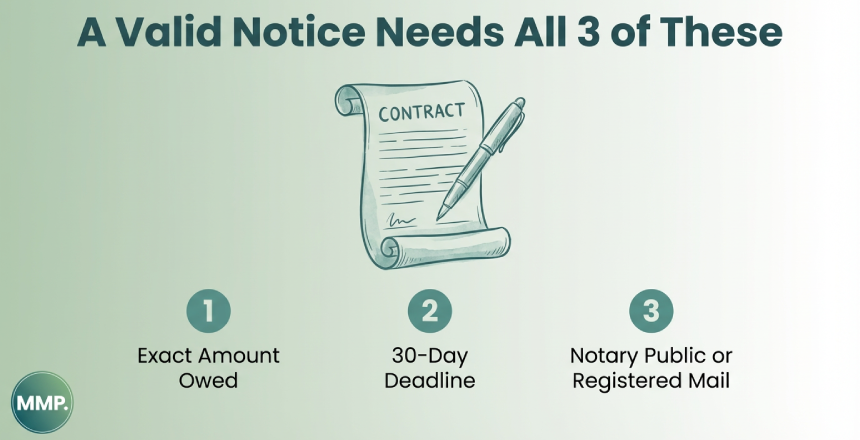
To properly serve a non-payment notice in Dubai, you have two valid options:
- Via a Notary Public — the most legally airtight method, and the one the Rental Disputes Centre most likes to see
- Via registered mail — traceable, timestamped, legally valid
The notice must state the outstanding amount, request payment within 30 days, and be correctly addressed to the tenant at the property. Simple, but it has to be done properly.
Check this first:
Is your Ejari registration current? Without a registered Ejari contract, you cannot file at the RDC at all. If it has lapsed, or you have been operating informally — fix that before anything else. It is the foundation everything else is built on.
3. Step Three: 30 Days Later — One of Two Things Happens
Best case: the tenant pays. You issue a receipt, document everything, and have a very direct conversation about what happens if this occurs again. Everyone moves on.
Less best case: the tenant has not paid. They may have gone quiet. They may be offering you a story that is now in its fourth instalment. In which case, you now have legal standing to file a case with the Rental Disputes Centre — the RDC — and things get considerably more official.
Filing at the RDC
The RDC operates under the Dubai Land Department and exists specifically to resolve situations like this one. You can file online via the DLD portal, or in person at the RDC head office on Baniyas Road in Deira.
Documents you will need:
- Ejari-registered tenancy contract
- Evidence of non-payment — bounced cheque, bank statement, payment records
- Copy of the formal notice you served, with proof of delivery
- Emirates ID and passport copy
- Title deed or proof of ownership
The filing fee is 3.5% of the annual rent, minimum AED 500, maximum AED 20,000. For cases combining rent recovery with eviction, the cap rises to AED 35,000. Cases and hearings can now be handled entirely online — which is genuinely useful if you are managing a Dubai property from outside the UAE.
4. What Actually Happens After You File
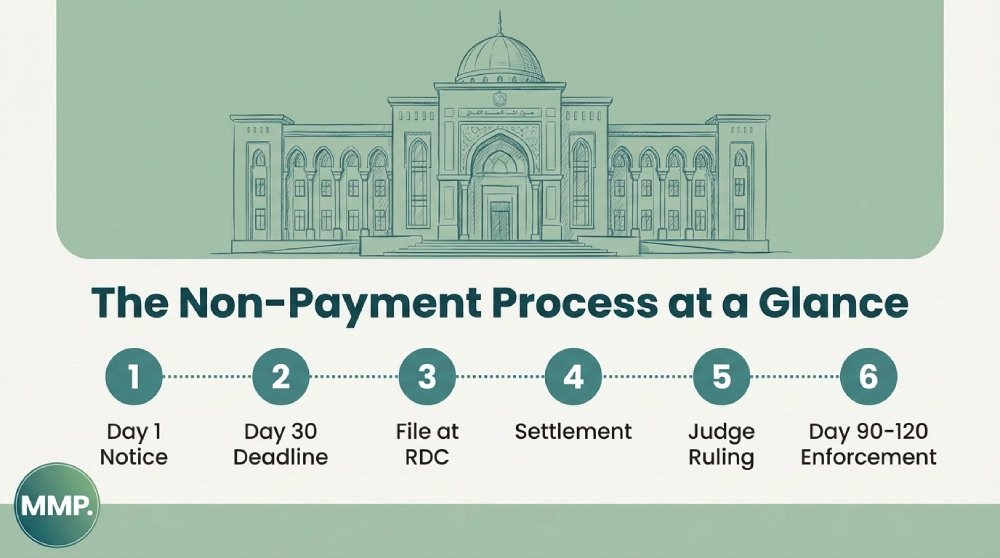
The process is structured, sequential, and — mercifully — has a defined endpoint. Here is what each stage looks like in practice:
- Amicable Settlement — Your case goes first to a conciliator who attempts to broker a resolution between both parties. Target timeframe: 15 days. More cases than you might expect are resolved here. The tenant agrees to a payment plan, clears the arrears, or agrees to vacate. Cheaper, faster, and less stressful for everyone — including you.
- First Instance (Lawsuit) — If conciliation fails, the case proceeds to a judge. Rulings typically target 30 days, though complex cases can take longer. Both parties present evidence. Hearings can be attended remotely. A binding verdict is issued.
- Enforcement — If the tenant still has not left or paid after judgment, the RDC Execution Department steps in and makes it physical. Exit bans and travel restrictions can also be applied for in serious non-compliance cases.
Total time from serving the 30-day notice to actual repossession, assuming no exceptional delays: three to four months. Not instant, but defined, enforceable, and with a clear finishing line.
Worth knowing:
Tenants can appeal an RDC judgment within 15 days. But execution continues unless a specific court-ordered stay is granted. The court may require from the tenant, a financial deposit as a condition of appeal. An appeal is not a pause button — it is an expensive gamble.
5. The Mistakes That Turn a Winning Position Into a Losing One
The law is on your side. These four things will quickly change that.
Cutting off the utilities
The logic is understandable: they are not paying, so you stop paying DEWA. Proportionate, feels justified, completely illegal.
Under Dubai tenancy law, a landlord cannot disconnect water or electricity regardless of how far behind on rent the tenant is. Doing so immediately puts you on the wrong side of an RDC case, exposes you to counter-claims, and can delay the very eviction you were trying to speed up. The temptation is real. The consequences are worse.
Changing the locks
Also illegal. Satisfying to imagine, genuinely illegal. A tenant holds a legal right of access to a property they are leasing, even if rent is unpaid. The only way to lawfully end that right is through an RDC judgment. Not a locksmith at 11pm on a Tuesday.
Verbal payment agreements
You had a conversation. The tenant seemed sincere. You generously agreed they could have until the end of the month. Nothing was written down.
You have now potentially reset your notice period and muddied your legal position considerably. Any agreement to extend, defer, or restructure payment must be in writing, signed by both parties, and filed somewhere you can find it. Verbal generosity, however well-intentioned, is legally invisible.
Waiting
Every month of patience is a month of lost rent with no guarantee of recovery. The legal process has a starting line. It is the moment you serve that first notice. The longer you delay starting, the longer every step after it takes.
Start the clock. Today, if possible. Yesterday if you can manage it.

6. Here Is What This Looks Like Without a Property Manager
You realise rent is late. You spend an evening researching whether WhatsApp counts as legal notice (it does not). You find a Notary Public. You draft the notice, serve it correctly, and track the 30-day deadline. Rent still does not arrive. You research RDC filing procedures. You gather five categories of documents. You file the case online. You attend the amicable settlement session. Then the First Instance hearing. Then you follow up on enforcement. The tenant finally leaves — four months later, and not quietly.
That is four months of your evenings and weekends spent becoming an amateur Dubai tenancy lawyer. On top of however many months of lost rent you are trying to recover.
Now here is what the same situation looks like with a professional property manager at MMP:
You receive a phone call explaining what has happened and what is already being done about it.
That is it. That is the entire difference between the two experiences.
An MMP property manager arrives at this situation with everything already in order — Ejari current, payment records maintained, tenancy contract airtight. They know the notice requirements, the RDC filing process, and how to combine rent recovery with a property damage claim if needed. They attend hearings on your behalf. They have been here before.
More importantly, a good property manager reduces the likelihood of ever arriving here at all. Rigorous tenant screening, post-dated cheque management, and proactive communication resolve most payment issues before they become legal disputes. The crisis you never have is the most valuable thing we offer.
The honest reality:
The Dubai landlords who end up in long non-payment disputes are, disproportionately, self-managing. Not because they are careless — but because managing a rental property properly is genuinely a full-time job. Most landlords already have one of those.
The Bottom Line
A non-paying tenant in Dubai is a solvable problem. The law is structured, the courts function, and you have every right to use them. What the law cannot do is serve the notice for you, file the case, or show up to the hearing.
If your tenant is not paying rent: start the clock today. And if the prospect of managing the rest of this process alone is what is giving you pause — that pause is telling you something worth acting on.
A tenant who is not paying is a problem. A landlord who does not know what to do about it is a significantly more expensive one.
Manage My Property handles the full rental lifecycle — from tenant screening to legal dispute resolution — so you are never navigating it alone.
Speak to an MMP Property Manager today: wa.me/971581177638
Frequently Asked Questions
What is the first step if my tenant hasn't paid rent in Dubai?
Serve a formal written notice through a Notary Public or registered mail — not WhatsApp or email. This officially starts the 30-day legal window under Article 25 of Dubai Tenancy Law. Do not wait — every extra day of informal chasing is legal time you’re giving away.
Can I cut off utilities if my tenant stops paying rent in Dubai?
No. Cutting off water, electricity, or access to the property is illegal in Dubai and will seriously damage your legal position. Follow the formal notice process through the RDC — taking matters into your own hands will work against you.
How do I file a case at the Rental Disputes Centre (RDC) in Dubai?
File online through the Dubai Land Department portal or in person at the RDC on Baniyas Road. You’ll need your Ejari-registered contract, proof of non-payment, a copy of the formal notice with delivery proof, Emirates ID, and your title deed. The filing fee is 3.5% of annual rent (min AED 500, max AED 20,000).
What if my Ejari has lapsed — can I still file at the RDC?
No. An expired or unregistered Ejari means your tenancy contract is not legally enforceable. You cannot file at the RDC without it. Renew your Ejari before taking any legal action — this is the most common mistake landlords make.
How long does the RDC process take in Dubai?
Most cases go through an initial amicable settlement stage within 2–3 weeks. If unresolved, the case moves to a judge. Straightforward non-payment cases typically reach a judgment within 4–8 weeks. Having all documentation in order from the start significantly speeds up the process.
Can overseas landlords file an RDC case without being in Dubai?
Yes. RDC cases can now be filed and managed entirely online. You can also appoint an authorised representative — such as a property manager with a valid Power of Attorney — to handle proceedings on your behalf.