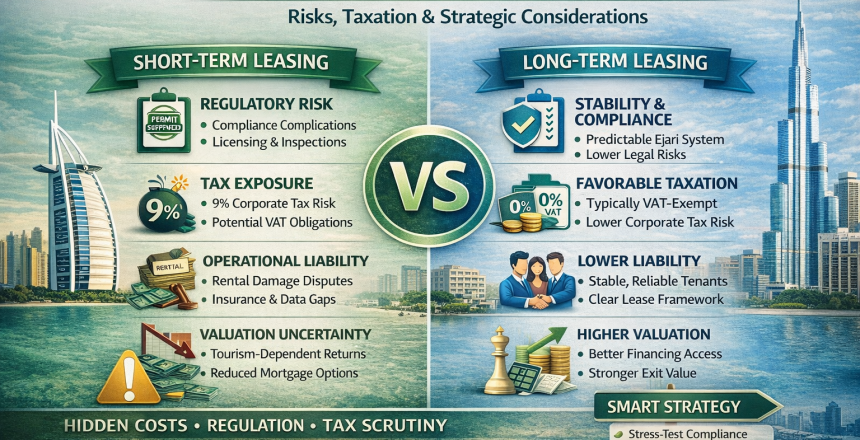
1. Regulatory Risk: Short-Term Rentals Are Not “Plug-and-Play”
Short-term leasing (holiday homes, Airbnb-style models) is not a default right of ownership.
It is a licensed activity subject to:
- Emirate-level regulations (e.g. DTCM in Dubai)
- Mandatory operator permits and unit registrations
- Ongoing compliance, reporting, and inspections
Key risk:
Non-compliance exposes owners to administrative fines, permit suspension, or forced cessation of activity, with immediate impact on cash flow assumptions.
Long-term leasing, by contrast, operates within a well-established, mature, and predictable legal framework (Ejari, RERA, civil law), with significantly lower regulatory volatility.
2. Tax Exposure: A Shifting Landscape You Cannot Ignore
Historically, many investors assumed short-term rentals to be “tax-light.” That assumption is now outdated.
Short-Term Leasing
- May be deemed a commercial activity
- Potential exposure to:
- Corporate Tax (from 9% onward, depending on structure and thresholds)
- VAT obligations (especially when bundled with services)
- Higher scrutiny on:
- Revenue recognition
- Expense deductibility
- Related-party management structures
Long-Term Leasing
- Typically classified as passive income
- Generally outside the scope of VAT
- Lower risk of corporate tax exposure when structured correctly
Hard truth:
Short-term income may look higher on paper, but net-of-tax, net-of-risk returns are often overstated in investor decks.
3. Operational & Legal Liability: Hidden Friction Costs
Short-term rentals introduce layers of liability that are frequently underestimated:
- Guest-related damages and disputes
- Insurance exclusions or premium inflation
- Consumer-protection claims
- Data privacy and booking-platform dependencies
From an audit standpoint, these translate into:
- Higher provisioning requirements
- Greater volatility in NOI
- Reduced predictability of distributable returns
Long-term tenants, while not risk-free, offer contractual stability, clearer eviction pathways, and far superior income visibility.
4. Valuation & Exit Risk: What Happens at Disposal?

Institutional buyers, banks, and conservative investors discount assets heavily when income is:
- Volatile
- Regulation-sensitive
- Dependent on discretionary tourism flows
Properties optimized exclusively for short-term leasing often face:
- Lower mortgage eligibility
- Reduced buyer pools
- Longer time-on-market at exit
Long-term leased assets remain far more liquid, financeable, and valuation-resilient.
MMP’s Position
At Manage My Property, we are not ideologically against short-term rentals. However, we are structurally conservative where investor capital is involved.
Our professional view is as follows:
- Short-term leasing is a tactical tool, not a default strategy
- It is suitable only when:
- Licensing is fully compliant
- Tax exposure is modelled conservatively
- Exit strategy is clearly defined
- For most investors, long-term leasing remains the superior risk-adjusted choice
What We Do for You
MMP actively:
- Stress-test rental strategies under regulatory and tax scenarios
- Models net returns after compliance, tax, and volatility
- Aligns property strategy with investor risk appetite and time horizon
If you are currently exposed to short-term leasing—or considering it—we strongly recommend a portfolio-level review before regulatory or tax enforcement tightens further.