- 7 min read
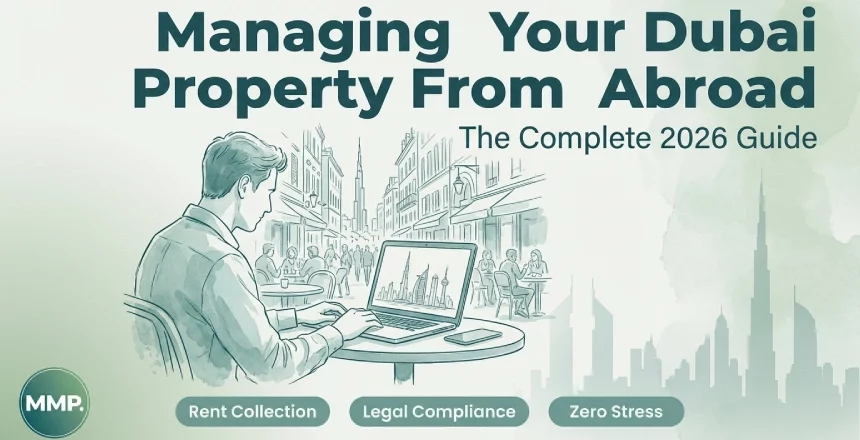
You own property in Dubai. You do not live there. Between those two facts sits a very specific set of challenges that nobody fully explains to you when you sign the purchase agreement.
You find out about them later — usually when rent doesn’t arrive on time, when a maintenance issue escalates because no one was there to catch it early, or when you realise you missed a 90-day legal notice window because you were four time zones away and nobody reminded you.
Dubai is one of the world’s most landlord-friendly markets. No income tax on rental earnings, strong regulatory protection through the DLD and RERA, high rental yields, and sustained international demand. The fundamentals are genuinely excellent. The operational reality of managing a property remotely, however, is a different matter — unless the right structure is in place from the start.
This is a practical guide for overseas landlords. What you need to have in place, what the common failure points are, and what competent professional management actually looks like in 2026.
The Legal Baseline: What Every Overseas Landlord Must Have in Place
Before getting into the operational side, there are three non-negotiables that apply to every non-resident landlord in Dubai. These are not optional extras — they are the legal and financial infrastructure your investment depends on.
A UAE bank account
Tenants in Dubai pay rent via post-dated cheques or, increasingly, through the UAE’s direct debit system (UAEDDS) — both of which require a UAE-based bank account to receive funds. International wire transfers are possible but slow, fee-heavy, and not how the standard Dubai rental transaction works. Non-residents can open savings accounts at major UAE banks without a residence visa, but you will need to visit in person. Emirates NBD, Mashreq, ADCB, and HSBC all service non-resident property investors. If your property is valued at AED 750,000 or above, the DLD’s Taskeen investor visa programme may also allow you to qualify for a UAE investor visa — which opens a current account with chequebook access.
Ejari registration
Every tenancy contract in Dubai must be registered on the Ejari system — the DLD’s official online registry of rental agreements. An unregistered contract offers you almost no legal protection. If a tenant defaults or refuses to vacate, a valid Ejari is the foundation of any legal case you file with the Rental Dispute Centre. Ejari can now be registered and renewed digitally via the Dubai REST app, which is a genuine advantage for overseas landlords — you no longer need to be physically present for this.
A Power of Attorney Limited to Managing Operations (optional but highly recommended)
A notarised operational POA allows a local representative — your experienced property manager, a legal professional, or a trusted individual — to act on your behalf for property-related matters. This becomes essential if there is ever a legal dispute, a document that requires in-person signing, or a government department that requires physical representation. In 2026, POAs issued abroad for UAE real estate purposes are valid for two years and must be digitally verified via the DLD portal — a QR code alone is no longer sufficient.
The shift to digital payments: Dubai is actively transitioning rental payments from post-dated cheques to the UAE Central Bank’s Direct Debit System (UAEDDS). Landlords who register with a participating bank can collect rent automatically, with missed payments carrying the same legal weight as a bounced cheque. For overseas landlords, this is the most significant operational improvement in years — rent arrives on the 1st, automatically, without anyone chasing anything. |
The Six Things That Go Wrong When You Self-Manage From Abroad
Most overseas landlords do not consciously choose to self-manage. It happens by default — the purchase completes, the developer hands over keys, and suddenly there’s a tenancy to run with no system in place. This is where the problems start.
Challenge | What happens without support | What MMP handles |
Rent collection | Chasing cheques across time zones. Delays. Missed payments that compound into disputes. | Rent tracked and collected. Funds deposited. You’re notified. |
Maintenance emergencies | Tenant calls you at 2am your time. You call a contractor who doesn’t pick up. | 24-hour response. Trusted contractor network. Issue resolved before you even know about it. |
Ejari registration & renewals | Easy to miss deadlines from abroad. Unregistered contracts = no legal protection. | Registered, renewed, archived. You receive confirmation. |
RERA compliance & rent increases | 90-day notice windows, RERA calculator requirements — missing these is a legal risk. | Renewal benchmarked against RERA index. Notice served correctly and on time. |
Property inspections | You have no idea what condition the property is actually in. | Routine inspections with photo reports. Issues caught before they become expensive. |
Legal disputes | Filing an RDC case from London or Mumbai is extremely difficult without a local representative. | MMP represents your interests locally. No flights required. |
The pattern across almost all of these is the same: issues that are small and manageable on-the-ground become expensive and stressful when they are handled remotely, reactively, and without a reliable local structure. The solution is not more WhatsApp groups with contractors. It is a properly managed arrangement from day one.
Pricing Your Property Correctly From a Distance
One of the less-discussed challenges for overseas landlords is pricing. Getting the rent wrong — in either direction — has a direct impact on yield and on how quickly you find a quality tenant.
Dubai’s Smart Rental Index, introduced by the DLD in January 2025, now rates individual buildings on a star classification system based on condition, amenities, and maintenance standards. This means the rental benchmark for your property is no longer just about area — it is about your specific building. A well-maintained building in a mid-market community can legitimately price above the area average. An older building in a premium location may benchmark below it.
From abroad, the only way to price accurately is to use the DLD’s Smart Rental Index calculator combined with live market data. This is standard practice for a professional property management in Dubai operation — but it is genuinely difficult to do reliably if you are checking Property Finder listings at midnight and making a judgement call.
The 2026 pricing reality: Rent growth has slowed to 4–6% citywide compared to double-digit increases in 2023–2024. In several apartment-heavy communities, new supply is giving tenants real negotiating power. Overseas landlords who overprice and then sit vacant for six to eight weeks lose far more than a slightly lower rent from the start. Accurate, market-aligned pricing from day one is the single most important yield decision you make. |
Maintenance: The Problem That Compounds When You’re Not There
Maintenance is the operational element that separates genuinely well-managed Dubai properties from the rest — and it is the area where overseas landlords are most exposed.
In Dubai’s climate, AC failure in July is not an inconvenience — it is an emergency that needs same-day resolution. A tenant whose AC is broken and cannot get a response from their landlord is a tenant who starts looking for alternatives and does not renew. A water leak left unaddressed for a week becomes a structural issue that costs ten times the original repair. These things happen in every rental property, everywhere. The question is how quickly and competently they get handled.
The challenge from abroad is not just the time difference. It is having a reliable, fairly-priced contractor network you can trust, knowing whether a quote is reasonable, being available to coordinate access, and following up to make sure the job was actually completed properly. Without a local partner managing this, even well-intentioned landlords end up with maintenance that is slow, expensive, or both.
- Regular inspections — at minimum twice a year — are how issues get caught before they become costly. These cannot happen remotely. They require someone physically in the property.
- A vetted contractor network means you are not calling a random number from a Google search every time something breaks. It means faster response, better work, and fair pricing.
- Maintenance documentation matters — for your records, for insurance, and for any eventual dispute with a tenant over the security deposit.
The Renewal — Where Most Overseas Landlords Leave Money on the Table
The annual renewal is the most financially consequential moment in your tenancy — and it is one that overseas landlords consistently handle poorly, not because they lack the information, but because they lack the time and the local context to handle it well.
Under Dubai law, any proposed change to rental terms — including a rent increase — must be communicated to the tenant at least 90 days before the contract expiry date. Miss that window and you legally cannot change the terms for the next renewal cycle. You also cannot increase the rent by more than the RERA Rental Index permits, regardless of what you think the market will support.
The common overseas landlord failure pattern: the renewal comes around, nobody has benchmarked the current rent against the RERA index, the 90-day notice is served late or not at all, the landlord either misses the opportunity for an increase they were entitled to or proposes an increase they were not entitled to — and the relationship with a good tenant deteriorates over an avoidable procedural mistake.
The renewal done correctly: 90 days before expiry: benchmark current rent against the DLD Smart Rental Index. Serve a formal renewal notice with any proposed changes. If the tenant agrees, issue the new contract and renew Ejari. If there is a dispute, the Rental Dispute Centre is the correct channel. None of this should land on your plate if you have a properly structured management arrangement. |
What Properly Structured Management Looks Like
The standard for managing a Dubai property from abroad is not particularly complicated — but it requires consistency, local expertise, and the right technology. Here is what it should include as a minimum:
- One dedicated manager who knows your property specifically — not a rotating call centre
- Routine property inspections with photo documentation sent to you
- Rent collection, tracking, and deposit into your UAE account — with a notification to confirm
- Ejari registration, renewal, and archiving handled without your involvement
- RERA renewal benchmarking and 90-day notice served correctly every cycle
- 24-hour maintenance response with a vetted contractor network
- Legal representation at the Rental Dispute Centre if required — without you needing to travel
- A live dashboard where you can see the status of your property, documents, and income at any time
This is exactly what Manage My Property provides. Every managed property has one certified dedicated manager, full access to the Dream platform for real-time visibility, and a management structure built specifically for landlords who are not in Dubai day-to-day. Our 98% average occupancy rate is not coincidence — it is the result of managing every element of the tenancy properly, every time.
The management fee is 7% of annual rent. For most properties, that is less than the cost of one week’s vacancy — which is precisely what good management prevents.
The Bottom Line
Dubai is an exceptional market for overseas property investment. No income tax. Strong legal framework. High yields relative to most global cities. Population growth that supports rental demand year on year.
The only thing that can undermine all of that is a poorly structured management arrangement that leaves you exposed to the operational realities of running a property across time zones. Rent collection problems, maintenance neglect, missed deadlines, and avoidable legal disputes are not inevitable — they are the predictable result of not having the right structure in place.
If you own property in Dubai and are not currently in the UAE, the most important investment decision you can make right now is not about which property to buy next. It is about how the one you already own is being managed today. Speak to an MMP property manager and we will give you an honest assessment of where your property stands.
Your Property Is in Dubai. You’re Everywhere Else. We’ve Got It.