- 6 min read
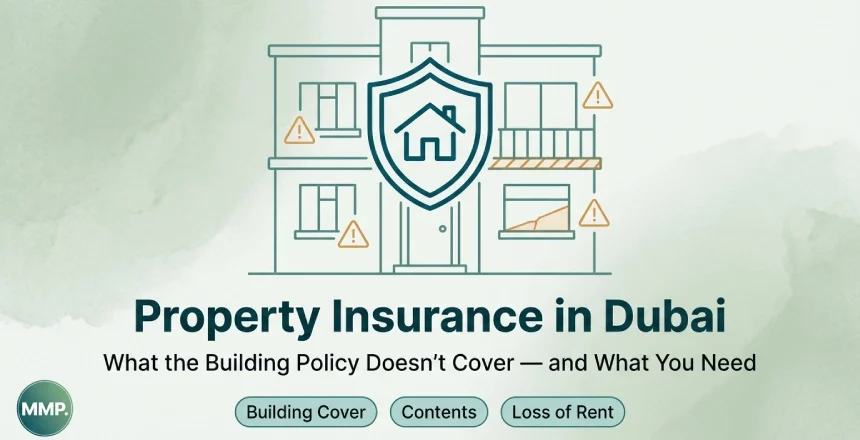
Most Dubai property owners have some form of insurance. Most of them are not entirely clear on what it actually covers.
This is not a criticism. The structure of property insurance in the UAE is genuinely spread across multiple parties — the building’s Owners’ Association has a policy, the bank may require one, the landlord can take out their own. These policies cover different things, are held by different people, and respond to different events. Understanding where one ends and another begins matters, because the gaps between them are exactly where landlords discover they are exposed.
Here is a clear guide to what property insurance actually covers in Dubai, what the OA’s building policy does not cover, and what a landlord renting out a unit needs to have in place.
You own property in Dubai. You do not live there. Between those two facts sits a very specific set of challenges that nobody fully explains to you when you sign the purchase agreement.
You find out about them later — usually when rent doesn’t arrive on time, when a maintenance issue escalates because no one was there to catch it early, or when you realise you missed a 90-day legal notice window because you were four time zones away and nobody reminded you.
Dubai is one of the world’s most landlord-friendly markets. No income tax on rental earnings, strong regulatory protection through the DLD and RERA, high rental yields, and sustained international demand. The fundamentals are genuinely excellent. The operational reality of managing a property remotely, however, is a different matter — unless the right structure is in place from the start.
This is a practical guide for overseas landlords. What you need to have in place, what the common failure points are, and what competent professional management actually looks like in 2026.
The Assumption That Costs Landlords Money
In Dubai’s strata-title apartment buildings, the Owners’ Association or building management arranges building insurance for the entire structure — funded through the service charges every unit owner pays. This covers the shell of the building: structural walls, common areas, shared systems, lifts, roof, and the building’s core infrastructure.
Many landlords assume this means their property is insured. It is — but only in the narrow sense that the building around their unit is covered. What sits inside that unit, and the financial interests of the individual landlord in it, are a separate matter entirely.
The OA policy will not respond to:
- Damage to your unit’s internal finishes, fixtures, and fittings above base specification
- Loss or damage to contents if your property is rented furnished
- Water damage originating within your unit — burst pipe, AC leak, overflowing appliance
- Accidental damage caused by your tenant inside the unit
- Your liability as the unit owner if a person is injured due to a fault within your property
The key distinction every landlord needs to understand: The building is insured by the Owners’ Association. Your unit — everything inside it, and your financial exposure as its owner — is your responsibility to insure separately. These are different policies covering different things, held by different parties. |
The Types of Property Insurance Relevant to Dubai Landlords
Property insurance in the UAE sits under an umbrella that includes several distinct types of cover. For a landlord renting out a unit in Dubai, these are the categories to understand:
Type | What It Covers | Landlord Needs It? |
OA Building Insurance | Structural shell, shared areas, building systems. Arranged by Owners’ Association. Funded through service charges. | ✓ Covered by default |
Building / Property Insurance | Your unit’s internal structure, fitted finishes, built-in fixtures and fittings. Responds to fire, water damage, accidental damage. | ✓ Yes — strongly recommended |
Contents Insurance | Furniture, appliances, electronics, furnishings. Essential for furnished rental units. | ✓ Yes — if furnished |
Home Insurance | Bundled policy combining building cover and contents in a single policy. Often the most practical option for landlords. | ✓ Yes — comprehensive option |
Loss of Rent Add-On | Optional add-on within some building or home insurance policies. Covers rental income if the unit becomes uninhabitable due to an insured event. | ✓ Worth considering |
Most UAE insurance providers offer these as standalone policies or as bundled home insurance packages. Annual premiums for property insurance in Dubai typically start from around AED 300 for apartments and rise based on property value, location, and coverage scope. For a unit worth AED 1 million, a comprehensive policy with contents cover generally costs well under AED 2,000 per year — a fraction of one month’s rent. If your property currently does not have its own insurance policy in place, you are effectively carrying 100% of the financial risk today.
Building Insurance: What It Covers and When You Need It
Building insurance in Dubai covers the physical structure of your specific unit — walls, floors, ceiling, built-in kitchen, bathroom fittings, and permanent fixtures. It responds to damage events including fire, water ingress from external sources, flooding, accidental structural damage, and in many policies, malicious damage by a third party.
For landlords with a mortgage, the bank will typically require building insurance as a condition of the loan. The bank is named as an interested party on the policy. Without it, financing is simply unavailable.
For cash purchasers renting out a property, building insurance is not legally mandated. It is, however, the policy that covers the most significant potential financial loss — structural damage to the unit itself. A fire that damages the kitchen, a burst pipe that destroys the flooring, a water leak from the unit above that ruins the ceiling: these are events that fall on the unit owner, not the OA, unless the cause originates in shared building systems.
The water damage question: Water damage claims are among the most common property insurance events in Dubai. The key question is always: where did the water originate? Damage caused by a leak from shared building pipes or another unit’s systems may involve the OA policy or the neighbouring unit owner’s insurer. Damage caused by a fault within your own unit — your AC, your pipes, your appliances — falls on your policy. Having your own building insurance means you are covered regardless of where the cause is eventually determined to lie. |
Contents Insurance: Non-Negotiable for Furnished Rentals
Contents insurance covers movable items inside the property: furniture, appliances, electronics, soft furnishings, and other personal or rental property belongings. It is distinct from building insurance, which covers what is permanently fixed.
For unfurnished rentals, contents insurance is less critical from the landlord’s perspective — the tenant’s own belongings are their responsibility to insure. For furnished rentals — which command a meaningful premium in Dubai’s short-term and mid-term market — contents insurance is not optional.
A furnished two-bedroom apartment in Dubai may contain AED 30,000 to AED 80,000 worth of furniture, appliances, and fittings. A building insurance policy will not replace these if they are damaged or stolen. Only a contents policy does.
Practical points for landlords arranging contents cover:
- Document everything with photographs and receipts before tenants move in
- Keep a written inventory — this is required for any claim and good practice regardless
- Check whether the policy covers tenant-caused accidental damage, not just theft or fire
- Review the sum insured annually — furnishing costs increase and policies need to reflect replacement value
Home Insurance: The Practical All-In-One Option
Home insurance in Dubai — sometimes called house insurance or property insurance interchangeably by UAE providers — is a bundled policy that combines building cover and contents cover in a single product. For most landlords, this is the most practical approach: one policy, one insurer, one renewal date.
Home insurance policies in the UAE vary significantly in what they include as standard and what they offer as add-ons. When reviewing any policy, the items worth checking specifically:
- Structural cover limit — should reflect the rebuild cost of your unit, not the market value
- Contents sum insured — must reflect actual replacement cost of furnishings
- Accidental damage inclusion — confirm whether this is standard or an optional extra
- Tenant damage cover — some policies include damage caused by tenants as standard; others require a specific add-on
- Loss of rent add-on — if the unit becomes uninhabitable due to an insured event, this covers your income during repair
- Vacancy clause — many UAE policies reduce or suspend cover if the property is unoccupied for more than 60 consecutive days; worth checking if you expect void periods
- Water damage scope — confirm exactly what causes of water damage are included vs excluded
Is Property Insurance Compulsory for Landlords in Dubai?
For mortgaged properties, yes — the bank requires building insurance as a loan condition.
For outright owners, there is no law that mandates a specific property insurance policy for landlords renting out units in Dubai. RERA’s regulatory framework governs tenancy rights and obligations, but does not legislate individual landlord insurance requirements in the way some other markets do.
What RERA’s framework does establish clearly is landlord responsibility for maintaining the property in a habitable condition and for structural and major repairs. If a failure in your unit causes loss or injury and you are found to have neglected that responsibility, the financial exposure is yours — insured or not.
The absence of a legal mandate does not reduce the financial logic. An uninsured water damage event, a fire in a furnished unit, or structural damage that makes the property temporarily unlettable can each represent a loss of AED 50,000 or more — multiples of the annual premium.
The proportionality point: Property insurance premiums in Dubai are, by most measures, low relative to the asset value they protect. For an apartment worth AED 800,000 renting at AED 70,000 per year, comprehensive building and contents cover typically costs AED 750–1,750 annually — less than 0.25% of property value. The case for having it is not complex. |
How Professional Property Management Supports Your Insurance Position
There is a direct relationship between how well a property is managed and both the likelihood of an insurable event occurring and the ease of making a claim if one does. Professional property management in Dubai does not replace property insurance, but it systematically reduces the conditions that lead to claims — and creates the documentation that supports them when needed.
Structured property inspections catch maintenance issues before they escalate into significant damage events. A vetted contractor network means emergency repairs — the burst pipe, the AC fault — are addressed quickly, reducing the extent of damage. Move-in condition documentation, with photographic evidence, provides the clear baseline that any insurer requires to assess a claim at the end of a tenancy.
Tenancy compliance monitoring ensures the property is being used as agreed — occupancy levels, permitted use, maintenance responsibilities — which matters because insurer exclusions for properties used outside their declared purpose are real.
Every property managed by Manage My Property is inspected on a structured schedule, with photographic reports kept on file. Maintenance issues are tracked from identification through to resolution. Financial records are maintained in real time through the Dream platform. This is not just good management practice — it is the paper trail that makes an insurance claim straightforward rather than contested.
The Bottom Line
Property insurance in Dubai is not complicated in principle. The building’s common areas and structure are covered by the Owners’ Association. Your unit — its internal finishes, its contents if furnished, and your financial exposure as its owner — requires a policy you take out yourself.
Building insurance covers the fabric of your unit. Contents insurance covers what is inside it. A home insurance policy combines both. And where relevant, a loss of rent add-on protects the income stream the entire investment is designed to generate.
The premiums are modest relative to the asset. The risk of not having cover is not.
Want your property managed so the risks stay manageable? MMP handles structured inspections, maintenance oversight, and property condition documentation — the management layer that keeps your asset protected and your insurance claims straightforward. We can review your current insurance position and help arrange appropriate coverage for your property within 24–48 hours. |