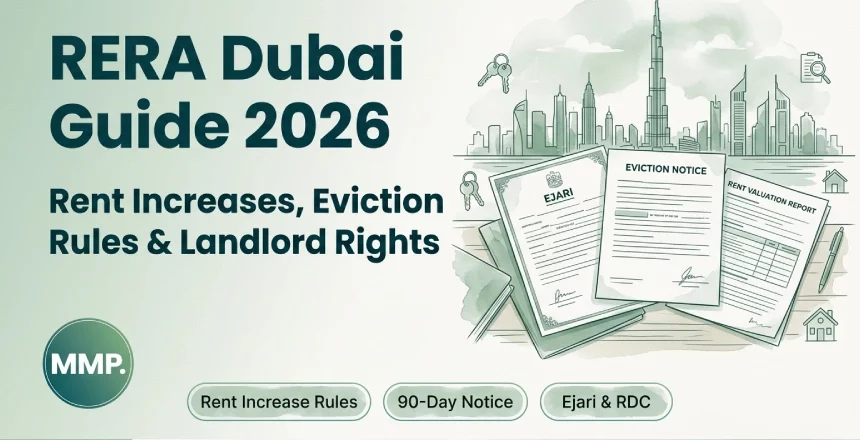
RERA — the Real Estate Regulatory Agency — is the authority that governs every tenancy in Dubai. Whether you own one apartment or a portfolio of properties, whether you are a tenant or a landlord, RERA’s rules directly determine what you can and cannot do, what you are entitled to, and what happens if either side steps outside those boundaries.
This guide covers everything landlords and tenants need to know about RERA in 2026: how rent increases work, what the 90-day notice rule actually means, what grounds justify eviction, how to use the RERA Smart Rental Index, and what to do when disputes arise.
What is RERA? The Real Estate Regulatory Agency (RERA) is a regulatory arm of the Dubai Land Department (DLD), established in 2007. RERA sets and enforces the rules governing all tenancy relationships in Dubai — including rent increase limits, Ejari registration requirements, eviction procedures, and the Rental Dispute Centre process. |
RERA Rent Increase Rules — The Complete Framework
One of the most commercially important things a landlord in Dubai can understand is the RERA rent increase framework. Many landlords miss increases they are entitled to because they do not know the rules. Many others attempt increases they are not permitted to make and create disputes that could have been avoided.
The framework works as follows: rent increases are governed by Decree No. 43 of 2013, which links the permitted increase to how far the current rent sits below the Dubai Smart Rental Index for that specific property type and location.
Current Rent vs Market Rate | Increase Permitted | Example (AED 80,000 rent) |
Within 10% of index (or above) | No increase permitted | No increase — even if market has risen |
11–20% below index | 5% increase | AED 80,000 → up to AED 84,000 |
21–30% below index | 10% increase | AED 80,000 → up to AED 88,000 |
31–40% below index | 15% increase | AED 80,000 → up to AED 92,000 |
More than 40% below index | 20% increase (maximum) | AED 80,000 → up to AED 96,000 |
The maximum permitted increase is 20% — and this only applies when the current rent is more than 40% below the market index. For most tenancies, the applicable increase will be 5% or 10%.
The 90-day rule — the most commonly missed legal requirement A landlord must serve written notice of a rent increase at least 90 days before the tenancy contract end date. If this notice is not served within that window, the right to increase rent is legally forfeited for that renewal cycle — regardless of what the RERA index says you are entitled to. No exceptions. MMP tracks renewal windows automatically for every managed property and serves notices within the required timeframe. |
How to Use the RERA Smart Rental Index
The RERA Smart Rental Index is the official tool for checking the market rate for any specific property in Dubai. It is publicly accessible at smartservices.rera.gov.ae and gives you the index value for your specific building, unit type, and location.
Here is how to use it correctly:
- Go to smartservices.rera.gov.ae — navigate to the Rental Price Calculator
- Select your property type (apartment / villa / commercial)
- Enter the emirate, area, and number of bedrooms
- The calculator shows you the average market rent for that configuration
- Compare your current rent against the index value to determine your increase entitlement
The index is updated periodically and reflects actual transaction data from the DLD. It is the legal benchmark — not asking prices on listing portals, not agent estimates. If a landlord proposes an increase above what the index permits, the tenant has a legal right to refuse it and escalate to the Rental Dispute Centre.
Important: The index is property-type and area-specific. The RERA index gives a range, not a single number. The relevant comparison is between your current contracted rent and the average for your specific property type in your specific community — not a general Dubai average. If you are unsure how to apply the calculation correctly, MMP’s certified property managers run this check as a standard part of every renewal cycle. |
Ejari — Why It Is Not Optional
Ejari is RERA’s mandatory tenancy registration system. Every tenancy contract in Dubai must be registered through Ejari — not after signing, not eventually, but before the tenancy has legal standing.
Ejari is not just a formality. Without a registered Ejari certificate, a tenancy contract is not legally binding under Dubai law. This has major practical consequences:
- A landlord cannot file a case at the Rental Dispute Centre without a valid Ejari registration
- A tenant cannot apply for a residency visa renewal or new visa without Ejari
- DEWA connection for the property requires a valid Ejari certificate
- A property cannot have two active Ejari registrations — the previous one must be cancelled before a new tenant can register
Registration costs AED 195 (online via Dubai REST app) or AED 239.75 at an approved service centre. Both the landlord and tenant are legally responsible for ensuring registration happens — in practice, it is typically handled by the tenant or the property management company.
MMP handles Ejari registration, renewal, and cancellation as part of the standard property management service in Dubai — automatically, without the landlord needing to track it.
Landlord & Tenant Rights Under RERA
RERA’s framework establishes clear rights for both landlords and tenants. Understanding both sides is important — not just your own.
Landlord Rights Under RERA | Tenant Rights Under RERA |
Right to receive rent on time as per the agreed contract | Right to occupy the property without landlord interference |
Right to collect a security deposit (5% unfurnished, 10% furnished) | Right to receive the property in good, liveable condition |
Right to increase rent (subject to RERA index and 90-day notice) | Right to contest any rent increase that exceeds the RERA index |
Right to evict a tenant who does not pay within 30 days of notice | Right to remain in the property even if it is sold to a new owner |
Right to reclaim property for personal use with 12-month notice | Right to receive all contract change notices in writing, 90 days in advance |
Right to carry out inspections with reasonable notice | Right to sub-let only if explicitly permitted in the contract |
Key landlord right that is commonly missed Even if the property is sold to a new owner during the tenancy, the existing tenancy contract remains fully valid and binding on the new owner. The tenant cannot be asked to leave simply because ownership has changed. The new owner must honour the existing contract terms until its natural expiry. |
RERA Eviction Rules — Grounds, Notice Periods & Conditions
Eviction in Dubai is legally structured. A landlord cannot simply ask a tenant to leave. Specific grounds, specific notice periods, and in some cases specific documentation are required. Attempting to evict outside these rules exposes the landlord to significant legal liability.
Eviction Ground | Notice Required | Key Condition |
Non-payment of rent | 30 days from notice | Tenant must fail to pay within 30 days of receiving notice |
Personal use by landlord or first-degree relatives | 12 months before contract end | No replacement tenant for 2 years after eviction |
Sale of the property | 12 months before contract end | Valid sale must proceed — cannot be used as a pretext |
Major renovation requiring vacant possession | 12 months before contract end | Dubai Municipality technical report required |
Demolition / government redevelopment | 12 months before contract end | Government order must be in place |
Lease violations (subletting, property damage, unauthorised use) | 30 days from notice | Must be documented with evidence |
The most commonly contested eviction ground is personal use by the landlord. If a landlord evicts a tenant claiming personal use and then re-lets the property within two years, the evicted tenant has the right to claim compensation from the Rental Dispute Centre.
Proper eviction procedures require formal notices served correctly and documented fully. MMP’s lease enforcement service handles all of this — from the first formal notice through to RDC coordination if required.
The Rental Dispute Centre (RDC) — How Dubai Handles Tenancy Disputes
The Rental Dispute Centre (RDC) is the Dubai government body responsible for resolving tenancy disputes between landlords and tenants. It handles rent increase disputes, eviction cases, deposit disputes, and general contract violations.
- Filing fee: 3.5% of annual rent (minimum AED 500, maximum AED 20,000)
- Cases can be filed online at rdc.gov.ae or in person at Dubai Courts
- A valid Ejari registration is required to file any RDC case
- The RDC process typically includes a mediation stage before a formal ruling
- RDC rulings are legally binding on both parties
- Appeals are possible but must be filed within 15 days of the ruling
The most important factor in any RDC case is documentation. The party with better evidence — condition reports, written notices, payment records, correspondence — consistently wins. Cases decided on the basis of verbal claims rarely go well for either side.
If you are facing a tenancy dispute, MMP’s legal representation service includes RDC coordination and full documentation support.
Key RERA Compliance Checklist for Landlords in 2026
A quick reference for where most landlord compliance gaps occur:
- Ejari is registered and current — not expired, not pending
- 90-day renewal notice has been tracked and served in writing within the window
- RERA Smart Rental Index has been checked before proposing any rent increase
- Proposed rent increase does not exceed the RERA-permitted percentage
- Move-in condition report was completed with photographs and signed by the tenant
- Security deposit amount matches the legal standard (5% unfurnished, 10% furnished)
- Any eviction notice has been issued on valid grounds with the correct notice period
- All tenancy communications have been documented in writing
Managing these compliance requirements manually across multiple properties is where errors accumulate. MMP’s Dream platform tracks every deadline — Ejari renewals, 90-day notice windows, contract expirations — automatically. Read more about professional property management in Dubai and what structured management changes for landlords.
The Bottom Line
RERA’s framework is well-structured and protects both landlords and tenants effectively — but only for those who understand and follow the rules correctly. The most common and costly mistakes come not from deliberately violating the rules, but from not knowing the 90-day notice window, not running the RERA index before a renewal, or not documenting a property’s condition at move-in.
For most landlords, the practical solution is ensuring the right processes are in place from the beginning of every tenancy. MMP’s property management services in Dubai are built around RERA compliance as a default — not an afterthought.
Have a question about RERA compliance for your Dubai property? MMP’s certified property managers handle RERA compliance as part of the standard service — Ejari, renewal notices, rent increase calculations, and dispute coordination. |